19. November 2025 | How-Tow

Fall Budget Tracker Hack: Insulated Bottle/Reusable Cup vs. Coffee to Go — What Households, Families & Students Really Save

Fall Budget Tracker Hack: Insulated Bottle/Reusable Cup vs. Coffee to Go — What Households, Families & Students Really Save

Why take a closer look right now in the fall?

As the days get colder, reaching for coffee, tea, or hot cocoa on the go becomes more common. Many small expenses add up surprisingly fast in a budget tracker. This article compares two habits - bringing your own in an insulated bottle/reusable cup vs. regularly buying coffee to go - with concrete calculation examples and practical entry tips for your budget tracker.

Quick comparison: two habits

In the fall, the numbers are often clear: A coffee to go costs on average between about 2.50 and 4.00 - depending on the drink and location. Homemade coffee or tea from home usually comes in far lower. The key is to transfer it into your budget tracker based on reality, instead of just estimating.

BehaviorCups/weekPrice/cupWeekly costMonthly cost (4.33 weeks)
Regular coffee to go 5 3.20 16.00 69.28
Bring your own (insulated bottle) 5 0.40 2.00 8.66
Mixed rule - 3x bring your own, 2x buy 5 mix 7.60 32.83

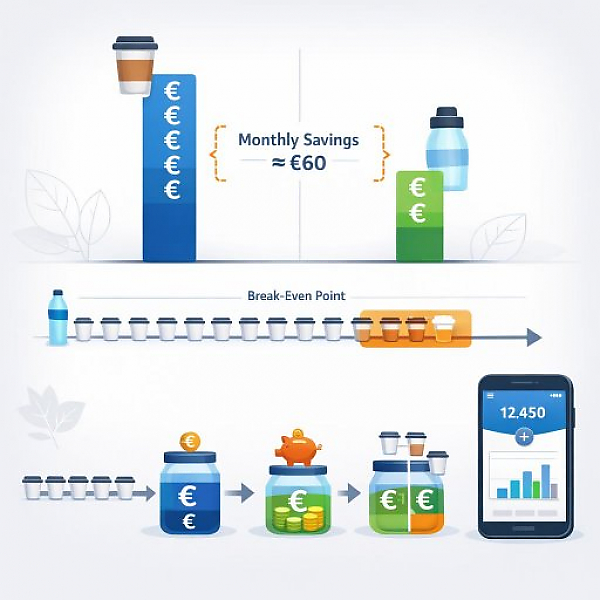
Example calculation: At 5 cups per week, coffee to go costs about 69.28 per month, while bringing your own costs only about 8.66. That’s a savings of about 60.62 per month.

Break-even calculation: when does the insulated bottle pay off?

Assume a good insulated bottle costs 30 as a one-time purchase. The savings per cup are 3.20 - 0.40 = 2.80. Break-even in cups = 30 / 2.80 = 10.7 cups. If you avoid 5 cups per week, the bottle pays for itself after about 2.1 weeks. Even with lower savings, the purchase usually pays off within a month.

Five seasonal saving tips for your budget tracker

  • Two-week tracking: For two weeks, note every cup (location, price, homemade yes/no). This creates a realistic average price per week/month. In a digital budget tracker, create a category such as On the go - Hot drinks and add tags like coffee-to-go or bring-your-own.
  • Log the break-even calculation: Enter the insulated bottle purchase once under a category like Household - One-time purchases and, in parallel, calculate the average savings per cup. This makes it easy to see after how many entries the investment paid off.
  • Batch prep for fall drinks: Make tea or cocoa concentrate, freeze in portions, or prep it in a thermos for taking along. Record the additional ingredient costs proportionally in your budget tracker under Pantry/Kitchen - per serving it’s often just a few cents.
  • Daily budget rule: Example: bring your own 3x per week, and record the remaining occasions as exceptions in the budget tracker. That way you stay in control and spontaneous purchases are consciously documented.
  • Family and student variations: For families: a thermos for daycare or an outing, and prep snacks at home as a combo instead of buying extras at the kiosk. For students: share reusable cups or fill a thermos in groups - entries in the budget tracker can be split proportionally per family/student group.

What budget tracker entries can look like in practice

Concrete entry examples:

  • Date: 10/15 - Category: On the go - Hot drinks - Amount: 3.20 - Note: Latte to go
  • Date: 10/16 - Category: On the go - Hot drinks - Amount: 0.30 - Note: Coffee from thermos (ingredients prorated)
  • Monthly note: Purchase insulated bottle 30.00 - Category: Household - One-time purchase

With tags like bring-your-own, coffee-to-go, kids, or campus, you can filter and compare spending. In budget tracker reports, trends become visible: more at-home prep in colder weeks, or higher spending during campus-heavy weeks.

Quick calculation to illustrate

Assume the normal situation: 5 cups/week, coffee to go 3.20, at home 0.40.

  • Monthly cost coffee to go: 5 x 3.20 x 4.33 = approx. 69.28
  • Monthly cost bring your own: 5 x 0.40 x 4.33 = approx. 8.66
  • Monthly savings: approx. 60.62
  • With a 30 purchase, that’s less than a month to earn back the cost.

Practical everyday tips

  • Keep thermoses and reusable cups clean - a quick wash becomes part of the routine.
  • If you do buy while you’re out, mark it as an exception - that keeps the overview intact.
  • Especially with kids: prep snacks and drinks together - that reduces combined to-go purchases.

Conclusion

If you track carefully for two weeks in your budget tracker and project the numbers, you’ll quickly see how much coffee to go costs in the fall. A one-time investment in an insulated bottle or a good reusable cup often pays for itself within a few weeks. With simple rules like a weekly or mixed budget rule, batch prep, and targeted entries in your budget tracker, you can achieve noticeable savings in the fall - for singles and students as well as for families.

Jetzt das Haushaltsbuch MyMicroBalance für Windows, Android oder iOS herunterladen