

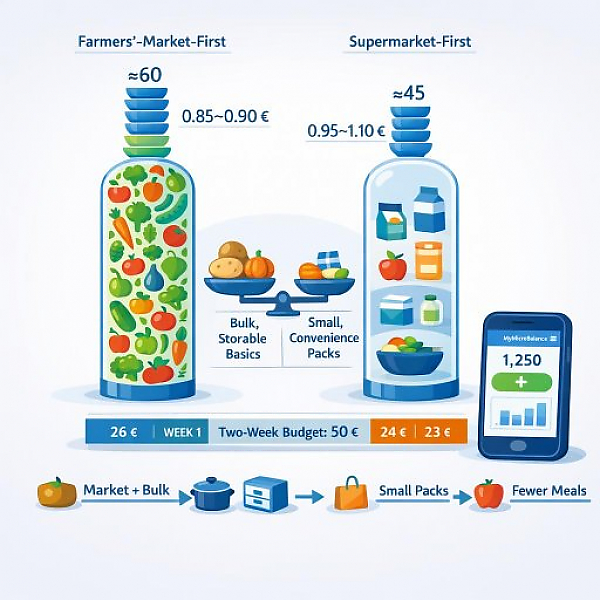
In October and November, seasonal produce is in high demand: winter squash, carrots, celeriac, leeks, potatoes, apples, and pears. These months are ideal for comparing two shopping strategies:
Both approaches can work, but they affect your wallet, pantry stock, and impulse buys in different ways.
The baseline is a fixed amount reserved only for fruits and vegetables in late fall. A realistic example for a two- to four-person household:
The question: How many meals can this cover under the two strategies, and how do the prices differ?
The figures below are fictional but based on typical October/November prices. They show how the budget can develop depending on the shopping strategy.
A market run with a consistent focus on regional, seasonal products:
| Product | Quantity | Price per kg / item | Total price |
|---|---|---|---|
| Winter squash | 3 kg | 1.80 euros/kg | 5.40 euros |
| Carrots | 2 kg | 1.60 euros/kg (market special) | 3.20 euros |
| Celeriac | 1 kg | 2.00 euros/kg | 2.00 euros |
| Leeks | 1.5 kg | 2.20 euros/kg | 3.30 euros |
| Potatoes (bag) | 5 kg | 1.40 euros/kg | 7.00 euros |
| Onions | 2 kg | 1.50 euros/kg | 3.00 euros |
| Apples (storage variety) | 3 kg | 2.00 euros/kg | 6.00 euros |
| Total week 1 | 29.90 euros |
Here, the 25-euro fall produce fund was slightly exceeded. On the next market visit, you can adjust deliberately—for example, one fewer item or smaller quantities.
A typical supermarket run that combines seasonal items with imports and convenience products:
| Product | Quantity | Price per kg / package | Total price |
|---|---|---|---|
| Squash (pre-cut, packaged) | 1 kg | 3.50 euros/kg | 3.50 euros |
| Carrots (1-kg bag) | 1 kg | 1.30 euros/kg | 1.30 euros |
| Soup vegetables (mixed pack) | 0.8 kg | 3.00 euros/kg | 2.40 euros |
| Potatoes (2.5-kg bag) | 2.5 kg | 1.60 euros/kg | 4.00 euros |
| Onions (net bag) | 1 kg | 1.40 euros/kg | 1.40 euros |
| Apples (import, glossy look) | 1.5 kg | 2.80 euros/kg | 4.20 euros |
| Grapes | 0.5 kg | 4.00 euros/kg | 2.00 euros |
| Cherry tomatoes (clamshell) | 0.25 kg | 7.00 euros/kg | 1.75 euros |
| Total week 1 | 20.55 euros |
This total is under 25 euros, but with a much smaller overall quantity and more expensive import or convenience products. That later affects the number of meals you can make.
A rough rule of thumb: For a main-meal serving with lots of vegetables, plan on about 250 to 300 grams of vegetables. For soups and stews it can be a bit less, but the side (for example, bread or rice) may cost a bit more.
The quantities purchased in week 1 are enough for approximately:
All in, this comes to about 26 to 30 meals/servings featuring vegetables from this shop, including snacks.
Using 29.90 euros in total costs, that works out to roughly:
1.00 to 1.15 euros per serving for the vegetable component.
With the supermarket quantities from week 1, you can cook approximately:
That comes to about 21 to 22 meals/servings featuring vegetables.
At 20.55 euros total cost, that yields:
about 0.95 to 1.00 euros per serving for the vegetable component.
At first glance, that looks similarly inexpensive. The difference becomes clear when you look at the fall produce fund over two weeks.
Assume the 25-euro budget is maintained for two weeks and, at the market, you deliberately use specials and end-of-day discount baskets.
In week 2 you might buy, for example:
Total for 2 weeks: 50.00 euros, but thanks to stocking up in week 1, the vegetables are enough for
Realistically, that adds up to 55 to 60 servings. Cost per serving then comes out to roughly:
0.85 to 0.90 euros per serving.
Total for 2 weeks: about 43.55 euros for a smaller overall quantity. With smaller packages, more convenience products, and less stocking up, you end up with roughly:
In total, that works out to about 40 to 45 servings. The cost per serving is therefore roughly:
0.95 to 1.10 euros per serving.
Over two weeks, the farmers'-market-first version makes the stocking advantage visible: More servings for a similar or only slightly higher budget.
Many farmers' markets offer baskets or crates of mixed produce shortly before closing time. Examples include:
For stews, soups, or batch cooking, appearance hardly matters. Especially in late fall, these discount baskets are perfect for getting base vegetables for:
You can often get very low per-kilo prices if you ask shortly before closing whether there are mixed crates or bulk discounts. This can save an additional 2 to 5 euros per week—or let you put that money into more vegetables.
Late fall is ideal for buying certain items in larger quantities and using them over several weeks:
Example with fictional numbers:
If you use 10 kg of potatoes per month, you pay about 14.00 euros in the farmers' market scenario and about 18.00 euros in the supermarket scenario. That's a 4.00-euro difference for just one product. Onions and apples show similar patterns.
Over a month, this can save 10 to 20 euros—or be reinvested in higher-quality, fresh vegetables.
Especially for families and students, it pays to plan one fixed prep night per week. This works with both shopping strategies, but it delivers the biggest benefit in the farmers'-market-first model, because many large-volume, fresh items get processed.
A possible flow:
This turns farmers' market purchases into predictable, low-cost meals. Last-minute food orders happen less often because prepped dishes are waiting in the freezer.
The biggest differences between farmers'-market-first and supermarket-first don't show up in the unit price of one apple or one carrot, but in the combination of:
A practical approach for the fall months:
Combined with a digital household budget tracker, it becomes clear how these habits affect monthly spending. Categories like fruits and vegetables or seasonal groceries help you compare weeks with a market visit to weeks without one.
In a direct price comparison, the supermarket often looks about as inexpensive as the farmers' market. Over two weeks, however, a different picture emerges: With a farmers'-market-first strategy, a fixed fall produce fund, and stocking up on storable items, you get more meals for the same or only slightly higher total budget.
Squash, potatoes, onions, and apples in particular shine in October and November. Big quantities with a low per-kilo price—combined with discount baskets and a weekly prep night—reduce the cost per serving noticeably. If you plan the farmers' market intentionally and use the supermarket mainly for top-ups, you benefit from fresh, seasonal food and a more relaxed monthly budget.




 1
1 2
2 3
3 4
4

