

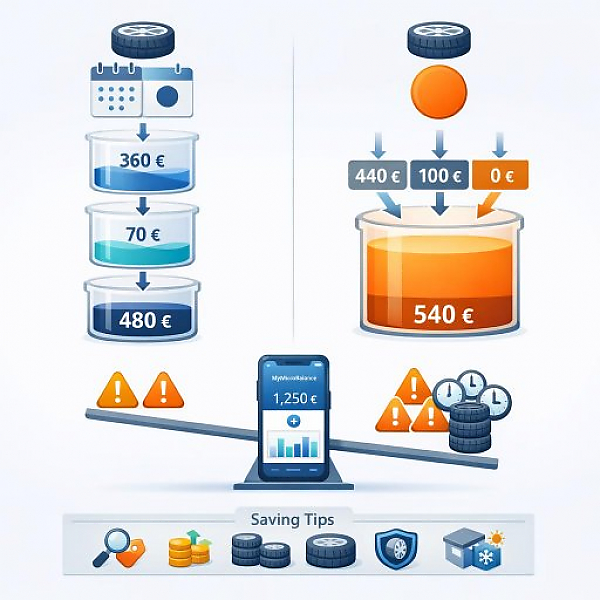
A fall tire change is a fixed expense for many households: new winter tires, installation, balancing, and often storage for the summer tires. Depending on your strategy, the same services can cost noticeably different amounts—or create the risk of extra costs. In the comparison below, we look at two typical approaches: buying early with staggered payments versus last-minute with a one-time payment and a bundled service package.
The examples are realistically calculated for a midsize vehicle (4 tires). Prices may vary by region.
| Buy early / staggered saving | Last minute / one-time payment with service bundle | |
|---|---|---|
| Tire price | 4 tires at promotional price: 4 x 90 = 360 euros | 4 tires at full price: 4 x 110 = 440 euros |
| Installation & balancing | Basic shop appointment: 1 x 70 = 70 euros | Service package (installation + balancing + quick check): 1 x 100 = 100 euros |
| Storage | Separate storage: 1 x 50 = 50 euros | Included in the package: 0 euros |
| Total | 480 euros | 540 euros |
| Payment method | Can be staggered: e.g., 300 euros at purchase, 180 euros at installation/storage | One-time payment when booking the appointment |
| Risk | Low risk of selling out, but appointment backlogs are possible | Higher costs, possible delays due to limited appointment availability |
Buying early with staggered saving saves money in most cases and reduces stress, because you can benefit from promotional prices and spread the costs more effectively. Last-minute with a service bundle can be worth it if a shop truly offers an inexpensive all-in package or if storage would be a short-notice problem. Overall, the cheapest strategy is the one that combines price tracking, early planning, and simple negotiation tactics. If you also focus on inspected used tires and proper storage, you can noticeably reduce costs over several years.



 1
1 2
2 3
3 4
4

