

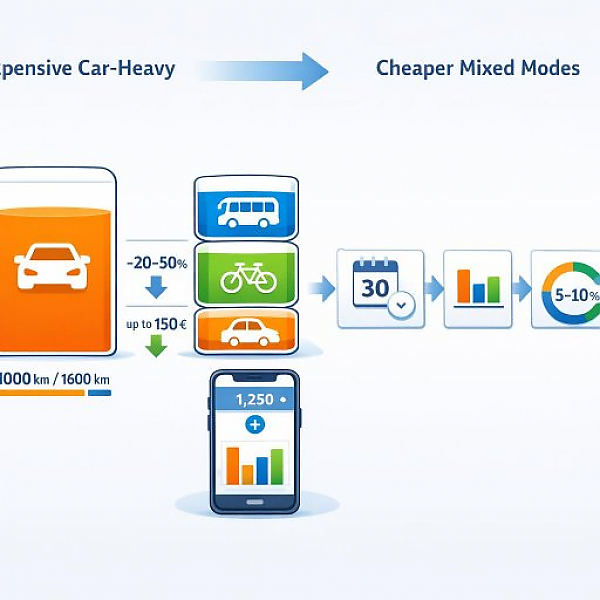
If you switch short trips from your car to biking or public transit in spring and bundle errands, you can often cut your commuting costs by 20–50%. Depending on your route, that can save you up to €150 a month.
So you can easily adapt the numbers to your own situation, we use simple, realistic averages:
Your actual numbers may differ. Below you’ll learn how to calculate your own numbers with a mini commuting budget log.
The table shows estimated monthly costs for singles and families. The baseline is always: all trips by car only. Then you’ll see what happens when you switch to public transit or biking.
| Scenario | Mode of transportation | Fixed monthly costs (insurance, taxes, pass, depreciation) | Variable cost per km (fuel, wear, electricity) | Assumed commuting distance per month | Total cost per month | Savings vs. “car only” in euros / percent |
|---|---|---|---|---|---|---|
| Single household | Car only | €200 | €0.25 per km | 1,000 km | €450 | – (baseline) |
| Public transit only | €80 (monthly pass) | €0 per km | 1,000 km (covered by the pass) | €80 | €370 / approx. 82% cheaper than car only | |
| Bike only | €20 (purchase over 5 years, maintenance) | €0.02 per km | 1,000 km | €40 | €410 / approx. 91% cheaper than car only | |
| Family with 2 kids | Car only | €250 (larger car, higher fixed costs) | €0.30 per km | 1,600 km | €730 | – (baseline) |
| Public-transit focused (family pass + some car use) | €180 (family transit passes + small car) | €0.15 per km (only about 400 km by car) | 1,600 km (1,200 km public transit + 400 km car) | €240 | €490 / approx. 67% cheaper than car only | |
| Mix of bike + public transit + minimal car use | €160 (public transit + 2–3 family bikes, car use heavily reduced) | €0.10 per km (only about 300 km by car) | 1,600 km (700 km bike, 600 km public transit, 300 km car) | €190 | €540 / approx. 74% cheaper than car only |
Important: These are average values. Your advantage: You can plug in your own miles/kilometers and euros to calculate your personal savings.
A mini budget log helps you learn your real costs. Here’s the simple process:
After 30 days, total it up:
With that, you can rebuild the table using your real numbers. Your advantage: You’ll see in black and white where you save the most.
Your main route is often your biggest cost driver: work, college, school. That’s where the biggest savings potential is.
How to plan a mix model:
Example calculation for a single (previously car only):
In this example, you save about €95 per month just by mixing modes. Your advantage: More money, without giving up the car entirely.
Try new routines before making permanent changes. Spring is ideal: It’s brighter and often drier.
How to plan two simple test weeks:
Then compare:
Then you can calmly decide how many car days you really still need.
For families, lots of small trips are expensive: school, daycare, hobbies, shopping. Your advantage: If you bundle trips, you save time and money.
Here’s how:
A simple family example:
Use your mini budget log to tailor these numbers more precisely to your family.
With a clear budget, you make every trip decision more consciously. That gives you control.
How to set your budget:
Once you know your budget, optimize your mix like this:
Your advantage: You actively decide what you spend your money on—not chance or habit.
Go through these points calmly, ideally with your mini budget log next to you:
If you start now, you can feel real savings as soon as next month. One possible plan:
This is how you reduce your commuting costs step by step by 20–50%—with clear numbers and without giving up your most important trips.



 1
1 2
2 3
3 4
4

