

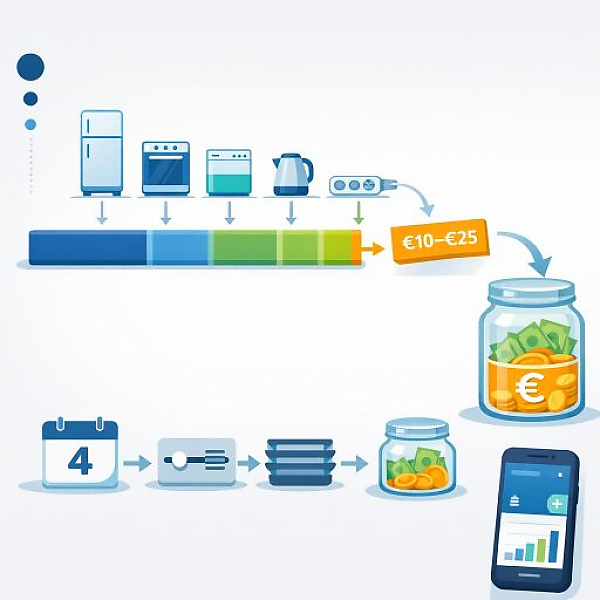
If you use your refrigerator, stove/oven, dishwasher, and electric kettle intentionally in spring, you’ll usually save €10–€25 per month. You don’t need new appliances. You just change your habits and plan your kitchen use better.
The table below shows typical usage, estimated current electricity costs per month, and savings potential from simple changes. It’s based on an electricity price of about €0.30 per kWh. All figures are rough examples for a 2–3 person household.
| Appliance | Typical use per week | Current electricity cost / month (estimated) | Savings potential (kWh & €/month) | Priority in your household plan |
|---|---|---|---|---|
| Refrigerator | 24 hrs per day, old setting 4–5 °C, often packed too full | €8–€10 | about 8–12 kWh less by setting 6–7 °C, good ventilation: €2.50–€3.50 | high |
| Stove/oven | 3–5 hot meals with the oven per week, often single dishes | €10–€14 | about 15–20 kWh less through batch oven cooking, convection, skipping preheating: €4.50–€6.00 | high |
| Dishwasher | 4–6 cycles per week, often at 60 °C or higher | €6–€9 | about 10–15 kWh less by using Eco mode, only running full loads: €3.00–€4.50 | medium |
| Electric kettle | 2–4 times daily, often too much water | €2–€3 | about 3–5 kWh less by filling the exact amount: €1.00–€1.50 | medium |
| Microwave | 2–4 times per week for reheating | €2–€3 | about 2–3 kWh less by reheating in batches, using a cover: €0.60–€0.90 | low |
| Coffee maker (drip/pod) | 1–2 pots daily or multiple single cups | €3–€4 | about 3–4 kWh less by using a thermal carafe, turning off the warming plate: €1.00–€1.30 | medium |
| Toaster & small appliances (blender, food processor) | several times per week, often left on standby | €1–€2 | about 2–3 kWh less by using a power strip with standby off: €0.60–€0.90 | low |
If you implement the high and medium priorities, you’ll usually reach €10–€25 in savings per month in spring.
To see your progress, you need a simple plan. Use a household budget, an app, or a notebook.
Your advantage: you quickly see which appliance costs you the most and where you can save the most with the least effort.
The refrigerator runs 24/7. Small changes make a big difference here.
Based on experience, many households save around 8–12 kWh per month this way, which is about €2.50–€3.50.
Budget tip:
The oven uses a lot of electricity, especially when you do many small baking sessions.
If you go from 4 separate oven days to just 1 batch-baking day per week, you can quickly save 15–20 kWh per month. That’s about €4.50–€6.
Budget tip:
When cooking, you can save a lot of electricity if you don’t waste heat.
If you boil 1–2 liters of water per day more efficiently, you’ll save an estimated 3–5 kWh per month, or about €1–€1.50. Combined with using lids and residual heat, it easily adds up to €2–€3.
Budget tip:
The dishwasher mainly needs a lot of energy for hot water.
If you switch from 60–70 °C programs to Eco and run fewer half-empty cycles, you can easily save 10–15 kWh per month, or about €3–€4.50.
Budget tip:
Even small appliances waste electricity when left on standby.
This saves roughly €2–€3 per month. It seems small, but over a year that’s already €24–€36.
To keep saving long-term, a short, fixed monthly check helps.
Important: Turn the savings into a small fixed savings rate.
This turns saving electricity in the kitchen into real money you can use for other things.
If you implement these steps gradually, you can very realistically save €10–€25 per month in your kitchen in spring—just by changing how you use things, without buying new appliances. You can start today.




 1
1 2
2 3
3 4
4

