

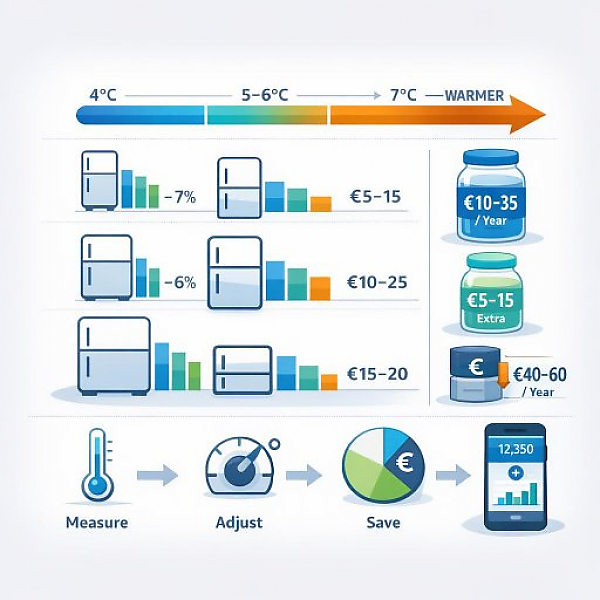
If you raise your refrigerator temperature in summer from 4 °C to 6–7 °C, you’ll save—depending on household type and appliance—about €5–€20 per year per degree. Up to 7 °C, food usually keeps well if you store it correctly.
In this guide, you’ll see:
The figures are sample values for summer operation in Germany. Assumptions:
Household types:
| Household type | Appliance condition | Annual usage 4 °C (kWh) | Annual usage 5 °C (kWh) | Annual usage 7 °C (kWh) | Annual cost 4 °C (€) | Annual cost 5 °C (€) | Annual cost 7 °C (€) | Savings per +1 °C (from 4 °C) (€ / %) | Recommended temperature |
|---|---|---|---|---|---|---|---|---|---|
| Single | old / inefficient | 220 | 205 | 185 | 77,00 | 71,75 | 64,75 | approx. €5.25 / 6–7% | 6–7 °C |
| Single | mid-aged | 170 | 160 | 145 | 59,50 | 56,00 | 50,75 | approx. €3.75 / 6–7% | 6–7 °C |
| Single | new / efficient | 140 | 132 | 120 | 49,00 | 46,20 | 42,00 | approx. €3.40 / 6–7% | 6 °C |
| Couple | old / inefficient | 280 | 260 | 235 | 98,00 | 91,00 | 82,25 | approx. €7.00 / 6–7% | 5–6 °C |
| Couple | mid-aged | 220 | 205 | 185 | 77,00 | 71,75 | 64,75 | approx. €5.25 / 6–7% | 5–6 °C |
| Couple | new / efficient | 180 | 168 | 152 | 63,00 | 58,80 | 53,20 | approx. €4.10 / 6–7% | 5 °C |
| Family with 2 kids | old / inefficient | 360 | 335 | 300 | 126,00 | 117,25 | 105,00 | approx. €8.75 / 6–7% | 5 °C |
| Family with 2 kids | mid-aged | 300 | 280 | 250 | 105,00 | 98,00 | 87,50 | approx. €7.00 / 6–7% | 5 °C |
| Family with 2 kids | new / efficient | 240 | 225 | 200 | 84,00 | 78,75 | 70,00 | approx. €5.60 / 6–7% | 5 °C |
| Shared apartment with 4 people | old / inefficient | 380 | 355 | 320 | 133,00 | 124,25 | 112,00 | approx. €8.75 / 6–7% | 5 °C |
| Shared apartment with 4 people | mid-aged | 320 | 300 | 270 | 112,00 | 105,00 | 94,50 | approx. €7.00 / 6–7% | 5 °C |
| Shared apartment with 4 people | new / efficient | 260 | 243 | 218 | 91,00 | 85,05 | 76,30 | approx. €5.95 / 6–7% | 5 °C |
Example: A family with a mid-aged refrigerator saves about €17.50 per year annualized when moving from 4 °C to 7 °C (€105.00 to €87.50). Each degree brings roughly €6 on average.
Important: Colder isn’t always better. Many households cool more than necessary.
Guidance by household:
Your benefit: According to the table, you often save €10–€35 per year just by changing the setting. You don’t need to buy anything new.
The dial usually only shows levels or symbols. It doesn’t tell you how many degrees it really is. Here’s how to check the actual temperature:
This way you can hit your target temperature, for example 5 or 6 °C, and use the savings potential from the table on purpose.
You can only manage your savings if you know roughly what the refrigerator costs. Here’s what to do:
Now compare with the table:
In your household budget (for example in MyMicroBalance), create a separate category such as “Cooling appliances electricity”. That makes the effect of the change easier to see later.
With better habits, you often save another €5–€15 per year. The table shows what a degree is worth. Typical savings effects by behavior:
You can roughly cross-check the effect using the table. Example: Your fridge costs €100 per year according to the table. 10% better habits then deliver about €10 in savings.
A new refrigerator costs a lot of money. You should check whether replacing it pays off through electricity costs. Use the table for this.
Here’s a rough way to calculate:
Now you can set a threshold:
You can take the annual extra burden from the table and compare it with the purchase price of a new appliance. This is not investment advice—just a simple household comparison.
Your refrigerator works differently in summer than in winter. With a fixed ritual, you keep your electricity budget stable.
At the start of summer (May/June):
In fall (October/November):
This builds a small routine. Your benefit: You only have to take action twice a year, but you save again every year.
If you implement these steps, you combine three effects: a better temperature, better habits, and a clear overview in your household budget. That’s how you unlock steady savings potential from your refrigerator—without giving up fresh food.



 1
1 2
2 3
3 4
4

