01. February 2026 | How-Tow

Cut Winter Electricity Costs with a Hot Water Check: How to Save Up to €180 a Year

Cut Winter Electricity Costs with a Hot Water Check: How to Save Up to €180 a Year

Cut Winter Electricity Costs with a Hot Water Check

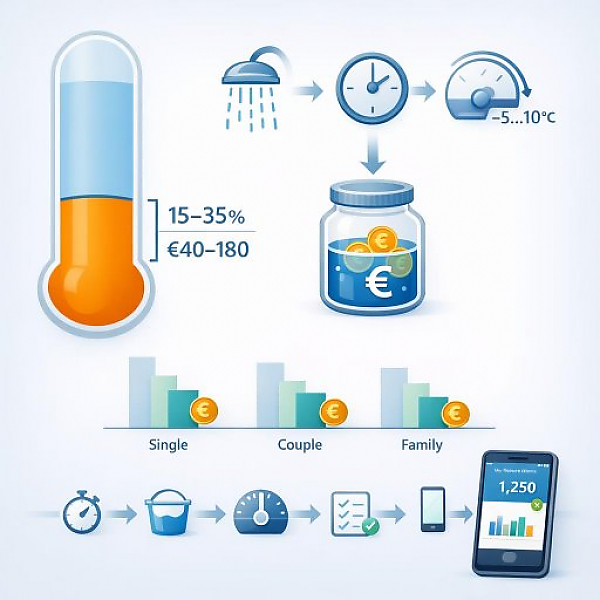
If you combine a low-flow showerhead, shorter shower time, and a slightly lower hot water temperature, you can save about 15–35% of your electricity costs for hot water per year, depending on household size. That’s roughly €40–€180, without having to give up comfort entirely.

How the numbers were calculated (simplified assumptions)

  • Electricity price: €0.32 per kWh
  • Only hot water for showering, not for baths or the kitchen
  • Average shower time before: 8 minutes per person
  • Average shower time after: 5–6 minutes per person
  • Status quo showerhead: approx. 12 liters per minute
  • Low-flow showerhead: approx. 7 liters per minute
  • Temperature reduction at the boiler / heater: 5–10 °C

Master Table: How Much Hot-Water Electricity You Can Save

The figures are rough averages from many real-world calculations. They show a realistic range. Your actual costs may be higher or lower. Use the table as guidance, not as an exact promise.

Household Annual electricity use for hot water (kWh) Annual costs (status quo) Low-flow showerhead only:
Cost / Savings / %
Temperature reduction only:
Cost / Savings / %
Combo (low-flow showerhead + temperature + shorter showers):
Cost / Savings / %
Single approx. 850 kWh €272 approx. €190
Savings: €82
approx. 30%
approx. €218
Savings: €54
approx. 20%
approx. €165
Savings: €107
approx. 39%
Couple (2 people) approx. 1,700 kWh €544 approx. €381
Savings: €163
approx. 30%
approx. €435
Savings: €109
approx. 20%
approx. €331
Savings: €213
approx. 39%
Family (4 people) approx. 3,200 kWh €1,024 approx. €717
Savings: €307
approx. 30%
approx. €819
Savings: €205
approx. 20%
approx. €625
Savings: €399
approx. 39%

For everyday life, you can remember this: Just by using a low-flow showerhead + showering a bit shorter, many households realistically end up with 15–35% lower electricity costs for hot water. The exact amount depends on your starting point.

Step 1: Measure your shower time and record it in your household budget

Before you change anything, take a close look first. You only need a stopwatch (your phone is fine) and a piece of paper or your household budget log.

  • For one week, take a closer look at every shower.
  • Start the stopwatch when the water is running.
  • Stop the time when you turn the water off again.
  • Record per person:
    – Date
    – Shower time in minutes
    – Time of day (morning / evening)
  • At the end of the week, calculate the average per person (for example, 9 minutes).
  • Enter this average duration in your household budget as a fixed figure: “Shower time: 9 minutes per person.”
  • Then set a goal, for example: “I’ll only shower for 6 minutes.”

Your benefit: You can see in black and white how much water and electricity you can save with every minute less. That makes saving concrete.

Step 2: Test a low-flow showerhead (bucket and stopwatch method)

A low-flow showerhead is often the fastest lever. You can measure the effect yourself.

2.1 Test the old showerhead

  • Place a bucket in the shower (e.g., a 10-liter bucket).
  • Set the shower temperature the way you normally shower.
  • Start the stopwatch and turn on the showerhead.
  • After 30 seconds, stop.
  • Measure how much water is in the bucket (e.g., 6 liters).
  • Double the value for 1 minute (6 liters in 30 sec. = 12 liters per minute).
  • Write down: “Old showerhead: 12 l/min” in your household budget.

2.2 Choose and test a low-flow showerhead

  • Choose a low-flow showerhead with a clear note about the flow rate, e.g., “6–8 l/min.”
  • Install the new showerhead (usually just unscrew and screw on).
  • Repeat the bucket test as above.
  • Write down the new value, e.g.: “New showerhead: 7 l/min.”

2.3 Roughly estimate savings

A simple rule of thumb for showering:

  • You roughly cut water consumption in half when you go from 12 l/min to 6–7 l/min.
  • That also significantly reduces the electricity used to heat the water.
  • The more people in the household, the greater the savings.

Enter the estimate in your household budget, for example:

  • “Low-flow showerhead installed on: 11/05”
  • “Expected electricity savings for hot water: approx. 20–30%”

Step 3: Lower the hot water temperature in small steps

Many boilers or water heaters are set higher than necessary. You can often turn them down a few degrees without feeling cold.

3.1 Check the starting value

  • Check the set temperature on the boiler or the heater (e.g., 60 °C).
  • Write down: “Starting hot water temperature: 60 °C.”

3.2 Lower in 2–3-degree steps

  • Turn the temperature down by 2–3 °C (e.g., from 60 °C to 57 °C).
  • Test for 2–3 days whether you can still shower comfortably.
  • If it’s still pleasant, lower it again by 2–3 °C.
  • Record each step in your household budget:
    – Date
    – New temperature
    – Comment: “still warm enough” or “too cold”

3.3 Note your comfort limit

  • If you notice, “Now it’s too cold,” go back up one step.
  • This temperature is your comfort limit.
  • Write down: “Comfort limit hot water: e.g., 48 °C.”

3.4 Estimate the impact in kWh and euros

Rough real-world guidance:

  • For every 5 °C less hot water temperature, you can save about 8–10% electricity for showering.
  • If you reduce, for example, from 60 °C to 50 °C, that’s 10 °C less. For typical households, that can mean roughly 15–20% less electricity for shower hot water.

Enter in your household budget, e.g., for a 4-person household:

  • “Before: €1,024 hot-water electricity (estimated)”
  • “After reducing by 10 °C: approx. €820–€870”
  • “Savings: roughly €150–€200”

Step 4: Set shower rules as a family contract

Families in particular save a lot when everyone participates. A simple “family contract” helps. Write the rules down and hang them in the bathroom.

4.1 Examples of clear shower rules

  • Maximum duration per shower:
    – Adults: e.g., 6 minutes
    – Kids: e.g., 5 minutes
  • Only one warm shower per day:
    – Short rule: “1 warm shower per day per person”
    – A cold rinse after sports is extra, or you plan it in
  • Use an order:
    – Set a fixed order for family members (e.g., kids first, then parents).
    – This way the family uses the residual warmth in the system, and the water needs less reheating.
  • Pause while soaping up:
    – Turn off the water while soaping up.
    – Turn it back on only to rinse.

4.2 Discuss the contract together

  • Sit down together as a family or shared household.
  • Briefly explain the background: “We want to reduce our electricity costs and have more money for other things.”
  • Show the rough figures from the table.
  • Agree on the rules together.
  • Everyone signs the “shower savings contract” (kids too, if you like).

Your benefit: Everyone knows why they’re doing it. That makes it more likely everyone will stick with it.

Step 5: Set a monthly check-in

If you don’t measure, you won’t see the results. A fixed appointment once a month is enough.

5.1 Check meter readings

  • Once a month, take a photo of the electric meter (for hot water).
  • Record the date and meter reading in your household budget.
  • Calculate how many kWh you’ve used since the previous month.

5.2 Briefly check shower habits

  • Ask your family: “Are we sticking to the shower times?”
  • Spot-check again with a stopwatch to see if the times match.
  • If showers start getting longer again, remind everyone of the contract.

5.3 Compare your monthly payments and actual costs

  • Look at your electricity monthly payments.
  • Write the monthly amount in your household budget.
  • Over the year, you’ll see whether your annual electricity consumption is going down.

5.4 Compare with the master table

  • Use your values from your household budget and meter.
  • Estimate how large your share of hot-water electricity is (e.g., 20–30% of your total electricity).
  • Compare with the table above for your household size.
  • If your savings are lower, check:
    – Are you showering longer after all?
    – Is the low-flow showerhead really installed?
    – Was the hot water temperature turned back up?

Your benefit: You’ll see whether your measures are really working. Then you can adjust in a targeted way.

Specific savings hacks you can do right now

To wrap up, here’s a quick overview. You can try these points today:

  • Today, measure shower time per person and note it on your phone.
  • This week, get a low-flow showerhead with 6–8 l/min and test it with a bucket.
  • This weekend, lower the hot water temperature by 2–3 °C and check comfort.
  • With the family, agree on a simple shower contract with a maximum time per person.
  • In one month, compare the electric meter reading and estimate the first savings.

If you implement these steps gradually, you’ll get very close to the figures in the master table. This is how you can realistically reduce your winter electricity costs for hot water by 15–35% and free up money for other important things in your day-to-day life.

Download the Budget Tracker MyMicroBalance for Windows, Android or iOS