

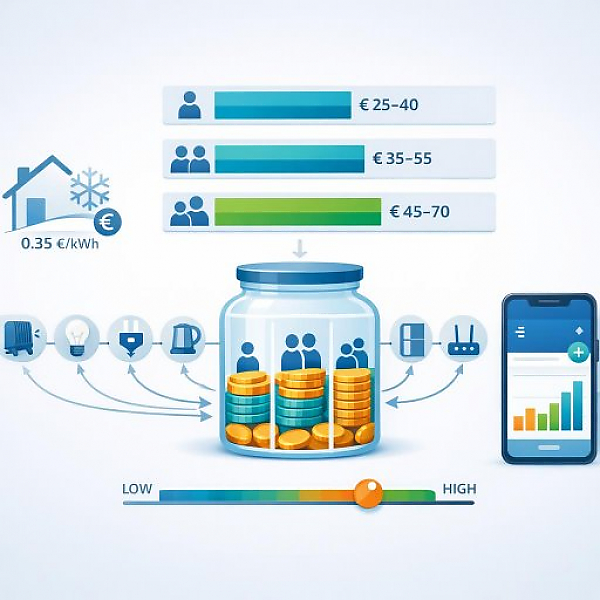
Key takeaway: In a typical older-building household, simple actions targeting 8–10 common winter electricity hogs can save about 25–40 euros per month (single), 35–55 euros (couple), and 45–70 euros (family with 2 kids)—without losing comfort, but with a bit of planning and consistent use of power strips with timers, efficient bulbs, and adjusted laundry and heating habits. This is based on an electricity price of 0.35 euros per kWh.
The table below summarizes the most important winter electricity-consuming devices in older-building apartments. The values are averages for the heating season (per month) and are meant as a guideline for a single-person household. In the euro-savings columns, you’ll find the typical monthly savings potential for single, couple, and family.
| Device / area | Avg. winter usage per month (kWh) | Monthly cost before optimization (euros) | Realistic savings from simple actions (kWh/month) | Savings euros/month single | Savings euros/month couple | Savings euros/month family (2 kids) |
|---|---|---|---|---|---|---|
| Electric space heater (supplemental heating) | 60 kWh | €21.00 | 35 kWh (limit usage time) | approx. €12.25 | approx. €14.00 | approx. €17.50 |
| Standby devices in the living room (TV, consoles, receiver) | 15 kWh | €5.25 | 10 kWh (power strips with switch) | approx. €3.50 | approx. €4.00 | approx. €4.50 |
| Refrigerator / fridge-freezer combo (older unit) | 40 kWh | €14.00 | 8 kWh (optimize temperature, defrosting, loading) | approx. €2.80 | approx. €3.50 | approx. €4.00 |
| Washing machine | 18 kWh | €6.30 | 7 kWh (30–40 °C, full drum) | approx. €2.45 | approx. €3.15 | approx. €3.50 |
| Clothes dryer | 30 kWh | €10.50 | 18 kWh (use a drying rack more often) | approx. €6.30 | approx. €7.00 | approx. €8.00 |
| Lighting (halogen & old bulbs) | 25 kWh | €8.75 | 15 kWh (LED instead of halogen, zone lighting) | approx. €5.25 | approx. €6.00 | approx. €7.00 |
| Electric kettle | 10 kWh | €3.50 | 4 kWh (heat only the amount you need) | approx. €1.40 | approx. €1.60 | approx. €1.80 |
| Dishwasher | 20 kWh | €7.00 | 8 kWh (eco program, run only when full) | approx. €2.80 | approx. €3.15 | approx. €3.50 |
| Router, small devices, other | 12 kWh | €4.20 | 5 kWh (timer, consistently switch off) | approx. €1.75 | approx. €2.00 | approx. €2.10 |
How to interpret this:
The higher amounts for couples and families come from more devices, longer usage times, and additional savings opportunities—especially with the washing machine, dryer, dishwasher, and lighting.
Before you change how you use appliances, you need a simple but clear snapshot—ideal for an overview in your household ledger or a personal finance app.
Electric space heaters are convenient but expensive stopgaps in older buildings. Even a few hours a day can push your bill up quickly.
In winter, lights run much longer in older buildings, often with old halogen spotlights or mixed setups. Switching cuts consumption immediately.
In winter, there’s often more laundry (thick clothes, bedding). In family households, this is where big differences show up between efficient and habitual use.
Older-building kitchens often have older refrigeration units, plus dishwashers and kettles. These offer easy savings with no loss of comfort.
Standby consumption adds up quickly over winter—especially when multiple entertainment devices are in use.
To make sure the savings show up not only on the bill but also in your budget, set up a small, clearly defined winter electricity budget.
Especially in older buildings, drafts and poorly sealing windows can drive heating costs up. Small insulation measures help further reduce the need for electric space heaters.
For households in older buildings, winter electricity costs can mainly be reduced through three levers: limiting supplemental electric heating, systematically replacing inefficient lighting, and optimizing how you use the washing machine, dryer, and kitchen appliances. The master table shows that realistic savings of 25–70 euros per month—depending on household size—are achievable if you consistently implement a handful of measures. By combining this with a clearly defined winter electricity budget in your household ledger, you keep consumption and costs under control and can make a well-founded adjustment to your monthly payment over time.

 1
1 2
2 3
3 4
4

