

As the days get colder, reaching for coffee, tea, or hot cocoa on the go becomes more common. Many small expenses add up surprisingly fast in a budget tracker. This article compares two habits - bringing your own in an insulated bottle/reusable cup vs. regularly buying coffee to go - with concrete calculation examples and practical entry tips for your budget tracker.
In the fall, the numbers are often clear: A coffee to go costs on average between about 2.50 and 4.00 - depending on the drink and location. Homemade coffee or tea from home usually comes in far lower. The key is to transfer it into your budget tracker based on reality, instead of just estimating.
| Behavior | Cups/week | Price/cup | Weekly cost | Monthly cost (4.33 weeks) |
|---|---|---|---|---|
| Regular coffee to go | 5 | 3.20 | 16.00 | 69.28 |
| Bring your own (insulated bottle) | 5 | 0.40 | 2.00 | 8.66 |
| Mixed rule - 3x bring your own, 2x buy | 5 | mix | 7.60 | 32.83 |
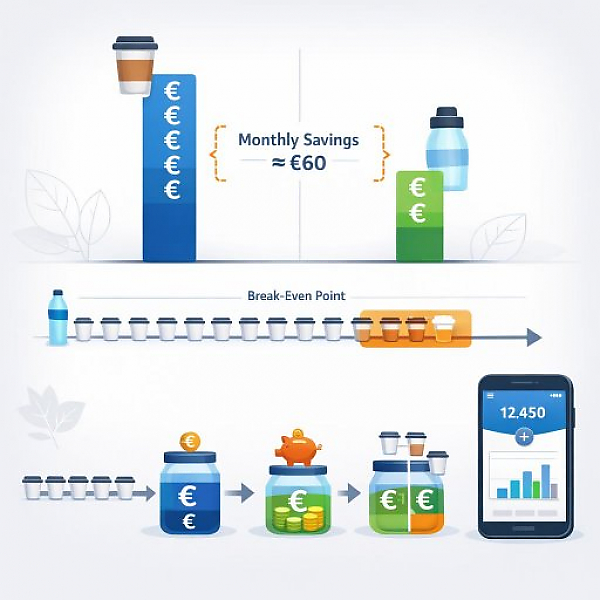
Example calculation: At 5 cups per week, coffee to go costs about 69.28 per month, while bringing your own costs only about 8.66. That’s a savings of about 60.62 per month.
Assume a good insulated bottle costs 30 as a one-time purchase. The savings per cup are 3.20 - 0.40 = 2.80. Break-even in cups = 30 / 2.80 = 10.7 cups. If you avoid 5 cups per week, the bottle pays for itself after about 2.1 weeks. Even with lower savings, the purchase usually pays off within a month.
Concrete entry examples:
With tags like bring-your-own, coffee-to-go, kids, or campus, you can filter and compare spending. In budget tracker reports, trends become visible: more at-home prep in colder weeks, or higher spending during campus-heavy weeks.
Assume the normal situation: 5 cups/week, coffee to go 3.20, at home 0.40.
If you track carefully for two weeks in your budget tracker and project the numbers, you’ll quickly see how much coffee to go costs in the fall. A one-time investment in an insulated bottle or a good reusable cup often pays for itself within a few weeks. With simple rules like a weekly or mixed budget rule, batch prep, and targeted entries in your budget tracker, you can achieve noticeable savings in the fall - for singles and students as well as for families.

 1
1 2
2 3
3 4
4

