

Leaf disposal is a typical seasonal line item in a household budget: tools, disposal, electricity or gas, and above all, time. In this article, we compare two approaches: DIY leaf cleanup versus a paid service provider. You’ll get concrete example calculations, common fall pitfalls, and practical money-saving tips — tailored to private households, families, and students in Germany, Austria, and Switzerland.
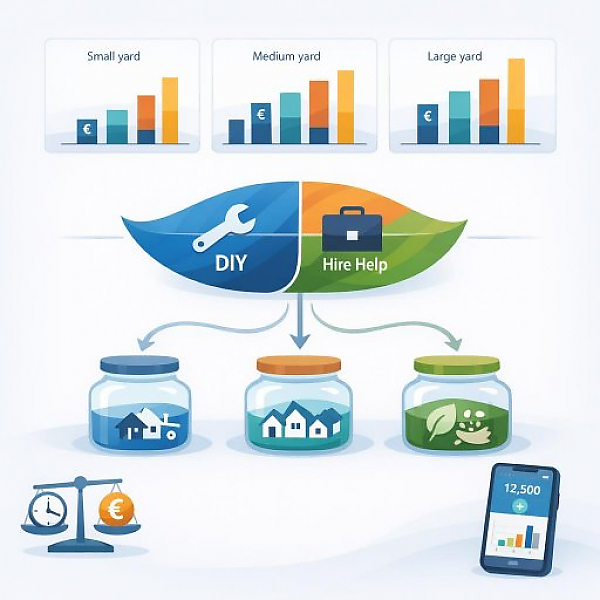
To keep the examples comparable, we use plausible average values (prices rounded): buying a battery-powered leaf blower incl. lawn rake and tarp: 230 euros. Equipment rental: 25 euros/day. Pro hourly rate (Germany, average): 40 euros/hour (slightly higher in Austria, significantly higher in Switzerland). Student help: 12–18 euros/hour. We look at three typical yard sizes and assume 3 sessions per season (drier fall phases): small 100 m2, medium 300 m2, large 800 m2.
| Case | DIY first season (purchase + ongoing) | DIY following year (annual, amortized) | Pro (one-time per season) | Rent + DIY (per season) | Student help (per season) |
|---|---|---|---|---|---|
| Small (100 m2, 3 sessions, total time ≈ 3 h) | ~266 euros (230 purchase + incidental costs) | ~62 euros/year (purchase over 5 years: 46 € + small materials) | ~135 euros (3 h × 40 € + travel) | ~75 euros (3 days rental × 25 €) | ~50–60 euros (3 h × 15 €) |
| Medium (300 m2, 3 sessions, total time ≈ 7.5 h) | ~285 euros (230 purchase + incidental costs) | ~80–90 euros/year (amortized) | ~320 euros (7.5 h × 40 € + travel) | ~100–125 euros (3 days rental / if needed 2 people) | ~110–140 euros (7.5 h × 12–18 €) |
| Large (800 m2, 3 sessions, total time ≈ 18 h) | ~336 euros (230 purchase + higher incidental costs) | ~100–120 euros/year (amortized) | ~750 euros (18 h × 40 € + travel) | ~150–200 euros (rental + possibly a second day) | ~220–320 euros (18 h × 12–18 €) |
Note: These are sample calculations with rounded values for orientation. Local pro hourly rates and disposal fees may differ. In Switzerland, hourly rates are typically higher (roughly budget +25–50 percent).
The Müller family, small house (100 m2): In the first season, the pro was cheaper (135 €) than buying (266 €). From the second year on, the family saves with DIY (about 62 €/year). Tip: Renting for a year or using a student service can be the cheapest transitional solution.
Gina & Tom, townhouse (300 m2): The purchase pays for itself quickly because they also use the leaf blower for other yard tasks. They save most by composting leaves and cutting fertilizer costs.
A property with a large yard (800 m2): Here, DIY is definitely cheaper long term; professional jobs are very expensive. Smart options: share the purchase (neighbors, family) or rent machines for peak periods.
In short: there’s no one-size-fits-all solution. For very small areas with no reuse for equipment, hiring a pro is often cheaper in the first season. For medium and larger areas, or if you’ll use tools over time, DIY pays off quickly — especially with rental options, neighborhood models, or student helpers. The biggest savings come when you treat leaves as a resource (compost, mulch) instead of paying to dispose of them.
If you keep a household budget, add a separate category for yard/leaves and try renting or a student helper for one year. Then you can decide based on real spending whether buying or hiring a pro is cheaper long term.
Write down the following values in your household budget: estimated hours per season, how many years you plan to use a tool, rental price per day, and the hourly rate for a pro/student. This lets you quickly identify which option is most cost-effective for your situation.
Good luck with leaf management — and a relaxed fall season!




 1
1 2
2 3
3 4
4

