19. October 2025 | How-Tow

Fall Leisure Budget: Pay-per-Event or Subscription Strategy — What’s Cheaper for Households, Families, and Students

Fall Leisure Budget: Pay-per-Event or Subscription Strategy — What’s Cheaper for Households, Families, and Students

Quick summary: What this is about

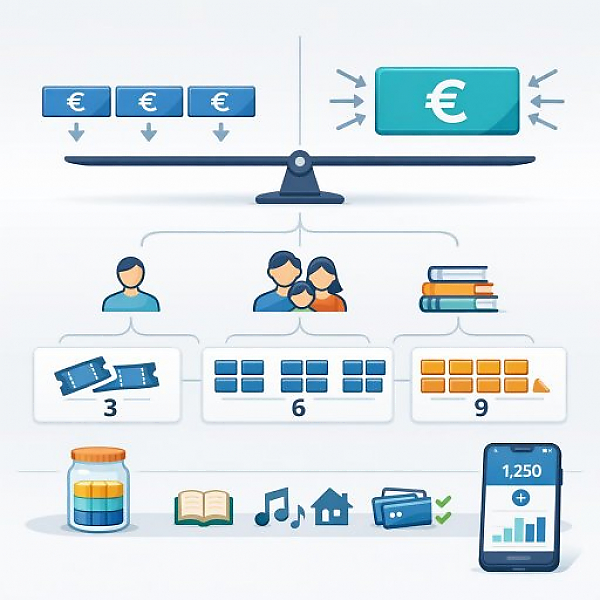
In the fall, spending on leisure tends to rise: museum visits on rainy days, movie nights, indoor sports, or indoor play areas. Two strategies compete: pay-per-event (pay individually) or subscription/flat rate/annual pass. This article compares both approaches for households, families, and students, shows simple break-even rules, and provides tips you can implement right away.

Comparison: Pay-per-event vs. subscription — the basic idea

  • Pay-per-event: You only pay when you actually go. Great for infrequent or variable outings.
  • Subscription/annual pass/flat rate: Pay once per year/month for unlimited or discounted entry. Great if you go regularly.

Which strategy is cheaper depends on how often you go, the cost per visit, and additional expenses (transportation, food). You’ll find the simple rule further below.

Practical calculator: The break-even formula

Here’s how to quickly calculate whether a subscription pays off:

  • Formula: Break-even visits per year = annual subscription price / average price per single visit
  • To convert to monthly: Break-even visits per month = break-even visits per year / 12

Typical price examples (benchmarks)

ActivitySingle ticket (approx.)Annual pass / subscription (approx.)
Museum €8–12 €40–90 (individual), €60–150 (family pass)
Movie theater €9–12 €80–120 (annual subscription)
Indoor sports (entry/per hour) €4–8 €40–80 (monthly pass/10-visit pass)
Indoor play area (per child) €5–10 €40–80 (season pass)

Note: Prices vary regionally (D/A/CH). Use your local prices as inputs in the formula.

Example calculations: What this looks like in practice

1) Student: movie subscription

  • Annual movie subscription: €90
  • Single ticket: €10
  • Break-even: 90 / 10 = 9 visits per year → 0.75 visits/month
  • Decision: If you want to go to the movies more than once a month in fall/winter, the subscription is worth it.

2) Family with 2 adults + 1–2 kids: museum

  • Family annual museum pass: €120
  • Single ticket per person: €10 → family of 4 = €40 per visit
  • Break-even: 120 / 40 = 3 visits per year
  • Decision: Starting at 3 family visits per year, the annual pass is cheaper. If distances/food costs are higher, it can pay off even sooner.

Tip 1: Create a monthly budget pool and run a 5-week test

How to quickly find out which strategy fits:

  1. Set up a small fall leisure budget as a pool, e.g., €5–10 per week per person (family: €20–40 per week).
  2. Track your spending for 5 weeks: how often did you go where, and how much were tickets, transportation, food?
  3. Then calculate the average cost per visit and use the break-even formula above.

Example: You set aside €7 per week → €35 in 5 weeks. During those 5 weeks, you went to the museum twice (€10 each) and to the movies once (€10) = €30 total. That means: frequency and patterns suggest occasional one-off purchases; no subscription needed.

Tip 2: Use free community offerings

On rainy days, libraries, neighborhood centers, and local cultural events are ideal alternatives. Use them as a substitute for paid events:

  • Library: story time for kids, game lending, free workshops.
  • Community/cultural center: open concerts, theater rehearsals, talks with low or no admission.
  • Schools/clubs: trial sports sessions or gym time with a small fee.

Specific alternatives per weekend (example):

  • Saturday: library in the morning with game borrowing, afternoon walk/outdoors, evening: themed movie at home.
  • Sunday: free family concert or neighborhood festival (if offered), alternatively a free museum day or special exhibit with reduced admission.

Tip 3: Systematically check bundle deals and family passes

How to run the comparison per person and per visit:

  1. Calculate total cost for individual visits: single ticket × number of people × planned visits.
  2. Compare with the annual pass/family pass.
  3. Factor in add-on costs: transportation (fuel/public transit), parking fees, snacks/food.
ExampleSingle tickets (1 visit)Annual passBreak-even
Kids’ indoor play area (family with 2 kids) €8 × 4 = €32 €80 (season pass) 80 / 32 = 2.5 visits → the pass is worth it starting at 3 visits

Include transportation: If each visit additionally costs €8 (gas/public transit, food), then the effective price per visit is higher, and the subscription becomes worth it sooner.

Tip 4: Backup strategies for stretches of bad weather

Plan low-cost at-home events and clear timing so you avoid spontaneous, expensive spending:

  • Themed movie night: one movie, a matching meal (make pizza at home), and a small “admission pot” for snacks.
  • Cooking challenge: each family member picks a low-cost recipe; create the shopping list together.
  • Swap meet: swap games or kids’ clothing — lots of fun, zero to low cost.
  • At-home Olympics or an arts-and-crafts afternoon using supplies you already have.

Timing rule: Set a weekly planning moment (e.g., Sunday 6 p.m.) to discuss the coming week’s leisure activities. This makes impulse buys less likely.

Quick decision rules (at a glance)

  • You go rarely (less than once a month): pay-per-event.
  • You go regularly (more than once a month): evaluate a subscription with the break-even formula.
  • Families with kids: calculate per family visit; family passes often pay off after just 2–3 visits/year.
  • Students: many offers have discounts — lower break-even.
  • Add transportation and food: if these are high, the subscription threshold drops.

Quick checklist before buying an annual pass

  • How often will you realistically use it? (plan real weeks/months)
  • Are there discounts for families, students, or combo tickets?
  • What add-on costs come with each visit?
  • Can you bundle visits (e.g., longer museum afternoons instead of short single visits)?
  • Are there free alternatives on rainy days?

Conclusion

A subscription is worth it when your expected usage exceeds the break-even threshold — and it’s not just ticket prices that matter, but also transportation and food. Set aside a small weekly budget as a test pool, track 5 weeks, and use the simple formula. Use libraries and community offerings as a low-cost substitute, and plan at-home events to reduce impulse spending. With these rules, you’ll quickly find the right strategy for your household.

If you’d like, post your typical fall week (number of outings, number of people) in the comments — and I’ll quickly calculate whether a subscription makes sense for you.

Download the Budget Tracker MyMicroBalance for Windows, Android or iOS