09. November 2025 | How-Tow

Fall Stew Budget Check: How Much Money Do You Save When You Meal-Prep and Freeze Soups & Stews?

Fall Stew Budget Check: How Much Money Do You Save When You Meal-Prep and Freeze Soups & Stews?

Quick summary

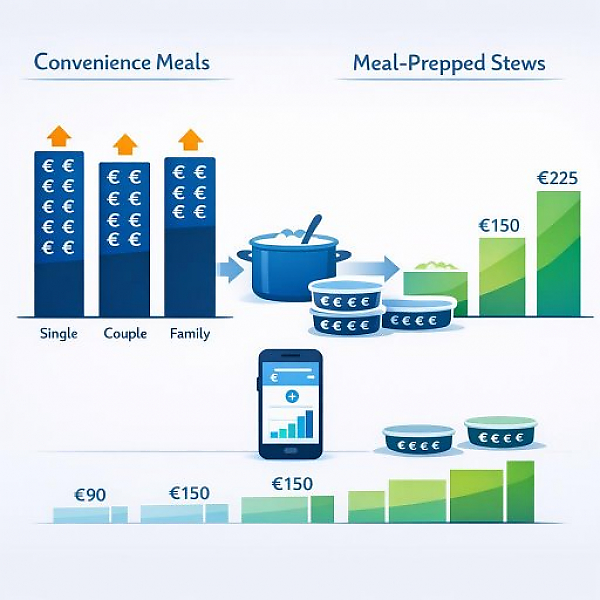
Batch-cooking fall soups and stews can noticeably reduce costs for many households. Our model calculation using fictional but plausible average values shows: If you cook ahead once per week, you can conservatively save about around 90 to 225 euros over a 12-week fall period, depending on household size and how many convenience meals you replace.

Methodology and assumptions

We use a typical 12-week fall period (September through November) and the following realistic assumptions:

  • Once per week, one stew/soup is cooked and divided into 6 portions.
  • Per-portion costs when meal-prepping (including ingredients, prorated energy, packaging) are set differently by household: single 1.20 euros, couple 1.10 euros, family 0.90 euros.
  • Alternative costs (without meal-prepping) are convenience meals, cafeteria food, or takeout: single/couple 4.50 euros per portion, family 4.00 euros per portion.
  • Replacement volume per week (assumed number of ready-made meals replaced): single 3 portions, couple 4 portions, family 6 portions.
  • These figures are fictional but practice-oriented; later sensitivity calculations show how price changes affect the outcome.

Model calculation: costs and savings over fall (12 weeks)

HouseholdPortions replaced / weekCost without meal-prep / weekCost with meal-prep / weekSavings / weekSavings over 12 weeks
Single (student) 3 3 x 4.50 = 13.50 € 3 x 1.20 = 3.60 € 9.90 € 118.80 €
Couple 4 4 x 4.50 = 18.00 € 4 x 1.10 = 4.40 € 13.60 € 163.20 €
Family (2 adults + kids) 6 6 x 4.00 = 24.00 € 6 x 0.90 = 5.40 € 18.60 € 223.20 €

This calculation shows savings in the range of about 120 to 225 euros for the three example households. If fewer portions are replaced, savings decrease accordingly; if more are replaced, they increase.

Mini example calculation (single), step by step

You’re single and replace 3 ready-made meals per week. Calculation:

  • Without meal-prep: 3 x 4.50 euros = 13.50 euros per week
  • With meal-prep: 3 x 1.20 euros = 3.60 euros per week
  • Saved: 9.90 euros per week → 9.90 x 12 = 118.80 euros over 12 weeks

Energy and storage costs: how relevant are they?

Batch cooking uses prorated energy, and there are small costs for freezing and packaging. Typical ranges:

  • Energy per batch (electric stove): about 0.5 to 1.5 kWh, i.e., roughly 0.20 to 0.60 euros at current electricity prices. With a gas stove, the pure costs are often lower.
  • Additional freezer share per portion: usually only a few cents (e.g., 0.02–0.08 euros) – because the freezer is running anyway.

In the per-portion costs above, these energy and storage costs are already included as a flat allowance. Overall, they are usually small compared with the convenience costs you avoid.

Sensitivity analysis: what happens if prices rise?

Price shocks can reduce savings. As a conservative assumption, we assume that significantly rising food and energy prices reduce the benefits of meal-prepping. If we model a reduction in savings of about 25% (conservative estimate), we get:

HouseholdSavings (base case)Savings (conservative, -25%)
Single 118.80 € ~89.10 €
Couple 163.20 € ~122.40 €
Family 223.20 € ~167.40 €

Bottom line: Even with unfavorable price trends, meaningful savings remain possible — in many cases still >80 euros over the fall.

4–5 concrete seasonal money-saving tips and action ideas

  • Meal-prep once per week: Cook one big pot and portion it into single-serving containers. This significantly reduces the per-person cost.
  • Use inexpensive fall vegetables and legumes: Pumpkin, carrots, rutabagas, onions, lentils, and beans are filling, nutrient-dense, and inexpensive in fall.
  • FIFO and portion-based planning: Label containers with the date, rotate inventory using the FIFO principle, and plan 6–8 portions per batch to use freezer space efficiently.
  • Cook energy-efficiently: Use a pot with a lid, use residual heat, and compare slow cooker vs. stovetop for long cook times. Calculate your break-even relative to the time invested.
  • Team up for more variety: Swap freezer jars with roommates or fellow students — less work for you and more variety.

Concrete implementation steps - 7-point plan

  1. Plan on the weekend: Pick a recipe with seasonal ingredients (e.g., pumpkin lentil stew).
  2. Write a shopping list for 6–8 portions and buy inexpensive vegetables strategically at the farmers market or a discount grocery store.
  3. Cook: Large batch, with a lid, using residual heat. Let it cool in portions and distribute into freezer containers.
  4. Label: Write the contents, number of portions, and freeze date on each jar/container.
  5. Pantry management: Store new portions in the back (FIFO) and check your inventory once a week.
  6. Recycle and share: Reuse packaging, swap jars, involve roommates.
  7. Track it in your budget: Log grocery costs and avoided convenience costs to make the savings visible.

Practical recipe ideas to get started

  • Pumpkin lentil stew (filling, inexpensive, freezes well)
  • Root vegetable soup with potatoes and white beans
  • Beet stew with lentils and dark bread on the side
  • Cabbage and rutabaga stew with smoked tofu or beans

Final recommendations

Meal-prepping and freezing is a simple, practical everyday step that can noticeably ease household budgets in the fall months. Your exact savings depend on how many ready-made meals you actually replace. Track your spending in a digital budget tool so you can see exactly how meal-prepping affects your budget.

Short answer: Yes, you can save a noticeable amount in the fall months — realistically, if you meal-prep once a week and replace some ready-made meals, savings of about 60 to 240 euros are possible, but most often in the range of about 90 to 225 euros depending on your household.

Download the Budget Tracker MyMicroBalance for Windows, Android or iOS