

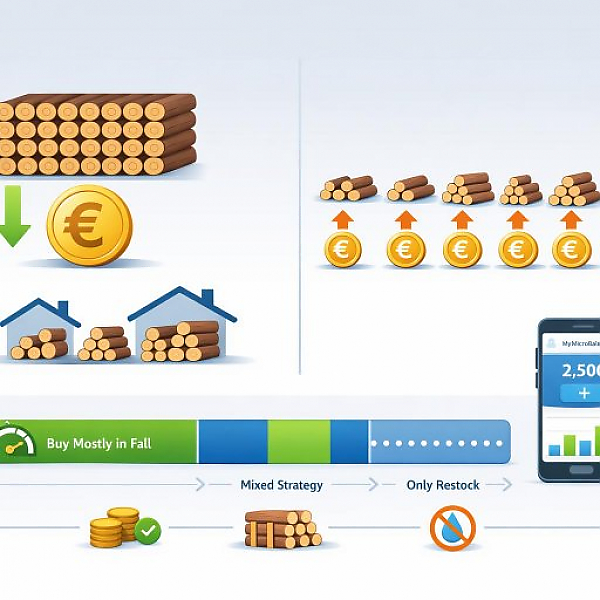
The question of buying in bulk vs. restocking piece by piece comes up for many households that heat with wood: Do you really save money if you order a lot of wood in the fall, or is flexibility in winter cheaper? In this article, we compare both strategies, provide simple calculation examples in euros and kWh, share seasonal money-saving tips, and help you make a decision for your household type.
Before you order: estimate your needs realistically. Three simple steps:
Typical annual usage (for orientation):
Prices and energy content vary; here are plausible example values we’ll use in the calculations:
In the following example, we compare two purchase times with concrete numbers. For simplicity, we assume softwood with 1 700 kWh/RM.
| Fall Purchase (Early) | Winter Purchase (Later) | |
|---|---|---|
| Price per RM (example) | 80 EUR/RM | 110 EUR/RM |
| kWh per RM | 1 700 kWh/RM | |
| Price per kWh | 0.047 EUR/kWh (80/1700) | 0.065 EUR/kWh (110/1700) |
Example calculation for three household types (excluding delivery costs):
Note: Delivery costs, wood species, moisture, and regional differences change the numbers. A delivery discount for larger quantities or combining an order with neighbors can increase the savings even further.
Reducing wood consumption means saving money. Pair your purchasing decision with measures that lower usage:
For households with medium to high firewood consumption and sufficient storage space, buying larger quantities in the fall usually pays off: better unit prices, lower risk of delivery bottlenecks, and typically drier wood. If you have limited space, tight finances, or very irregular heating needs, you’ll benefit from restocking piece by piece or using a mixed strategy. Combine purchasing with savings measures like sealing drafts, heating strategically, and group orders to achieve the best price-to-performance mix.




 1
1 2
2 3
3 4
4

