24. March 2026 | How-Tow

Goal-Based Household Budget: Simple Definition and Guide to Digital Budgeting

Goal-Based Household Budget: Simple Definition and Guide to Digital Budgeting

What is a goal-based household budget?

A goal-based household budget is a planned spending and saving plan where you first define clear financial goals and then intentionally allocate your monthly income in a digital budget book to those goals before you plan flexible expenses like groceries or entertainment.

Example: Goal overview table for your goal-based household budget

In a digital budget book like MyMicroBalance, you can create a separate category for each goal. The following table shows a typical example of four household goals with target amount, monthly contribution, category, and priority.

Goal name Total target amount Monthly contribution Category in the budget book Priority (1 = very important)
Emergency fund / savings reserve 3,000 € 150 € Savings: Emergency fund 1
Annual insurance 600 € 50 € Reserve: Insurance 2
Larger purchase (e.g., bicycle) 800 € 80 € Savings: Purchase 3
Buffer for unplanned expenses 500 € 40 € Buffer / Reserve 4

Core principle: Goals first, then spending

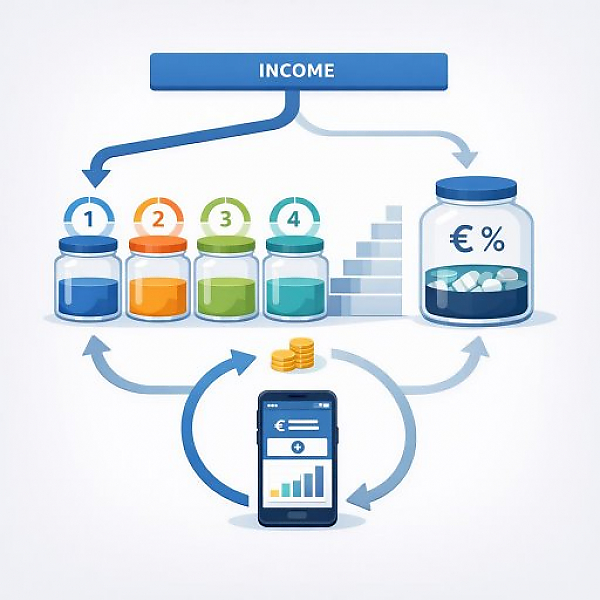
With a goal-based household budget, you don’t start only from your expenses. You start with your household goals. A goal can be a savings reserve, a planned bill, or a purchase. The idea is:

  • You set fixed goals and target amounts.
  • You split your income each month into fixed contributions for those goals.
  • Only then do you plan how much money is left for variable expenses such as food, leisure, or shopping.

This way, you secure what matters most first and reduce the risk of having no money left for your goals at the end of the month.

Step by step: From the first goal entry to monthly goal tracking

The following steps show you how you can implement a goal-based household budget in practice in a digital budget book like MyMicroBalance.

Step 1: Record income per budget period

First, you need a clear overview of your income. A budget period is usually a month.

  • Open your digital budget book (e.g., MyMicroBalance).
  • Record all regular monthly income (e.g., salary, alimony/child support, rental income).
  • Also record irregular income if it is foreseeable (e.g., bonus payments or a side job).
  • Calculate the total of your monthly income. This amount is the basis for your goal-based household budget.

Step 2: Define 3–5 specific household goals

Next, define your most important household goals. A few clear goals are better than many vague ideas.

  • Choose 3 to 5 goals, for example:
    • Emergency fund: Money for emergencies like repairs or sudden expenses.
    • Annual insurance: Insurance that is only charged once per year.
    • Larger purchase: For example a new bicycle, furniture, or tech.
    • Buffer: A small reserve amount for unplanned expenses each month.
  • Set a total target amount for each goal (e.g., €3,000 for the emergency fund).
  • Assign a priority to each goal: What matters most? For example, the emergency fund has priority 1.

Step 3: Set monthly contributions and create categories

Now break your goals down into monthly amounts. This turns a big goal into an achievable monthly contribution.

  • For each goal, consider the time frame in which you want to reach it (e.g., 20 months for a €3,000 emergency fund).
  • Divide the target amount by the number of months. This gives you the monthly contribution (e.g., €3,000 / 20 = €150 per month).
  • Check whether the sum of all contributions fits your income. If not, adjust the time frame or individual goals.
  • Create a dedicated category for each goal in your digital budget book, for example:
    • Savings: Emergency fund
    • Reserve: Insurance
    • Savings: Purchase
    • Buffer / Reserve
  • In your personal overview or notes, record the desired monthly contribution per category.

Step 4: Consistently assign income and expenses

For your goal-based household budget to work, all transactions must be assigned to the right goals or spending groups.

  • When your income comes in, plan or book the monthly contributions directly into the goal categories (e.g., €150 to Savings: Emergency fund).
  • Every expense is assigned to a category immediately when you record it, for example:
    • Grocery store purchase → Category Groceries.
    • Car repair → Category Car / Repair.
    • Money you intentionally set aside as a buffer → Category Buffer / Reserve.
  • Use the analysis features of your digital budget book (e.g., charts and reports in MyMicroBalance) to see how much has already been booked for each goal category during the month.

Step 5: End of month – review the goal overview

At the end of each budget period, check whether you reached your planned contributions.

  • Open the category analysis and check the booked amount for each goal category.
  • Compare this value with your planned monthly contribution.
  • For each goal, note:
    • Goal met (planned contribution reached or exceeded) or
    • Goal missed (planned contribution not reached).
  • If you missed goals, consider:
    • Was the goal set too high?
    • Were there one-time special expenses?
    • Can you give this goal a higher priority next month?

Step 6: Continuously adjust your budget and goals

A goal-based household budget is not a rigid system. It benefits from regular adjustments.

  • If your income changes, adjust the monthly contributions.
  • If you reach a goal (e.g., you fully saved up for annual insurance), you can:
    • create a new goal or
    • shift the freed-up amount to another goal with a higher priority.
  • Use your digital budget book to compare trends over multiple months. This helps you see whether you are getting closer to your goals or whether you should make changes.

Why a goal-based household budget is especially useful in a digital budget book

A goal-based household budget works on paper, but it is much clearer in a digital budget book like MyMicroBalance.

  • You can see at any time how much has already been saved or allocated per goal category.
  • You can quickly adjust transactions if they were assigned to the wrong category.
  • With just a few clicks, you can see whether your current spending structure matches your goals.
  • You keep an eye on long-term goals as well, which often occur only once a year.

Summary: The core idea of the goal-based household budget

A goal-based household budget puts your goals first. You don’t just plan what you spend—you primarily plan what you intentionally set aside for important purposes. Combined with a digital budget book like MyMicroBalance, this creates a clear, repeatable process: record income, define goals, set contributions, consistently assign transactions, and review at the end of the month. This turns your budget book into a tool that guides you step by step toward more financial organization and security.

Download the Budget Tracker MyMicroBalance for Windows, Android or iOS