12. April 2026 | How-Tow

How Much Money Does Meal Prepping Save in Early Summer? Cut Your Food Costs by Up to 35%

How Much Money Does Meal Prepping Save in Early Summer? Cut Your Food Costs by Up to 35%

Introduction: How much you can save with early-summer meal prepping

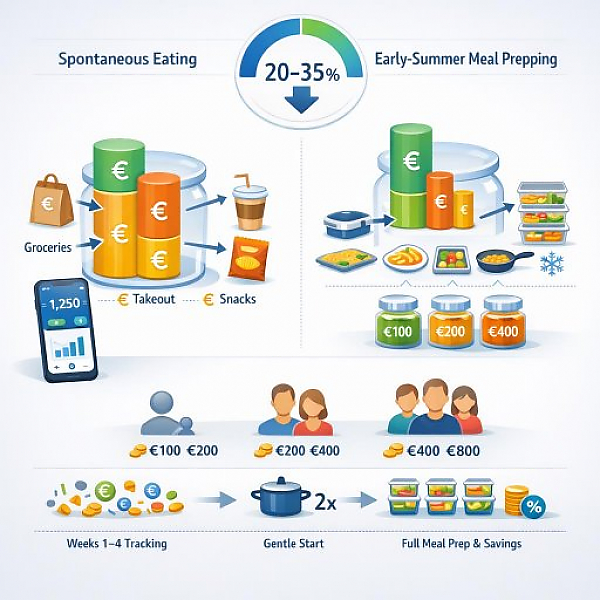
If you cook ahead 5 evenings per week in early summer and plan for leftovers, you’ll save about 20–35% of your food costs in everyday life. The larger the household, the more it pays off. For a family, €100–€150 a month is quickly within reach.

Master table: What does food really cost you? (Single, couple, family)

The table shows typical averages in Germany. These are estimates, not promises. This gives you a feel for how strongly meal prepping can work.

Household type Scenario Avg. days eating out per week Grocery costs per week Extra costs (delivery / takeout) per week Total cost per month Potential savings vs. spontaneous
Single A) Spontaneous + often to-go 4 €60 €40 €430 -
B) Early-summer meal prepping 1 €70 €10 €320 €110 / about 26%
Couple A) Spontaneous + often to-go 4 €110 €70 €780 -
B) Early-summer meal prepping 1 €130 €20 €580 €200 / about 26%
Family (4 people) A) Spontaneous + often to-go 3 €200 €120 €1.280 -
B) Early-summer meal prepping 1 €230 €40 €880 €400 / about 31%

You can see: with meal prepping, you spend a bit more money at the supermarket. In return, expensive impulse buys and delivery orders drop sharply. That’s where the savings come from.

Step 1: Know your baseline (budget-tracking trick)

Before you start, it’s important to know: how much do you really spend today? Only then will you see how much you save later.

Tip 1: Create a new category “impulse food on the go”

  • Use your budget log or a simple list on paper.
  • Create a separate category: “Impulse food on the go”.
  • For example, record:
    • Snacks at the train station
    • To-go coffee
    • Takeout during your lunch break
    • Delivery at night
  • Write down every purchase immediately or in the evening.
  • Do this for 4 weeks.

Your benefit: you’ll clearly see how much money goes just toward impulse eating. That makes every euro you save later twice as motivating.

Step 2: A fixed early-summer weekly plan with 3 base meals

With a simple plan, meal prepping isn’t stressful. You only need three ingredient “families” that are easy to adapt.

Tip 2: Choose three base meals

  • 1 pasta dish: e.g., pasta with a veggie sauce.
    • Base: inexpensive pasta from a discount grocery store.
    • Early-summer vegetables: tomatoes, bell peppers, zucchini, fresh herbs.
    • Variation: once with cheese, once with legumes like lentils.
  • 1 sheet-pan meal: roasted vegetables with carbs.
    • Base: potatoes or rice (cook separately and add to the sheet pan).
    • Vegetables: carrots, zucchini, bell peppers, onions.
    • Variation: with budget-friendly protein sources like eggs or chickpeas.
  • 1 skillet meal: a quick veggie stir-fry.
    • Base: rice, couscous, or bulgur.
    • Vegetables: whatever is on sale.
    • Variation: sometimes with egg, sometimes with a bit of cheese, sometimes with tofu or leftover meat.

Plan these three dishes for 5 days per week. Cook each dish so it yields two meals: one fresh, one as leftovers.

Sample weekly plan (for a single person—scale up for a couple/family)

  • Monday evening: cook a pasta dish (2 portions).
    • Monday: 1 portion fresh.
    • Tuesday: 1 portion for lunch or dinner as leftovers.
  • Tuesday evening: prep a sheet-pan meal (4 portions).
    • Tuesday: 1 portion fresh.
    • Wednesday: 1 portion as leftovers.
    • Freeze or refrigerate 2 portions.
  • Wednesday evening: skillet meal (2–3 portions).
    • Wednesday: 1 portion fresh.
    • Thursday/Friday: leftovers for lunch or a quick dinner.

Your benefit: you almost always have something ready or half-ready in the fridge. That way, on hot days you don’t end up “without a plan” and only rarely call expensive delivery services.

Step 3: A fixed meal-prep time slot—just 90 minutes per week

Meal prepping only works if it fits your daily routine. A fixed appointment helps a lot.

Tip 3: Do a real prep session once a week

  • Choose a fixed time: e.g., Sunday evening for 90 minutes.
  • Prep several base components:
    • Grains: 1 large pot of rice, pasta, or potatoes.
    • Vegetables: 2–3 sheet pans of roasted veggies or big bowls of raw veggies.
    • Sauces / dips: simple tomato sauce, yogurt dip, oil-and-vinegar dressing.
  • Portion everything into containers or jars.
  • Label containers with contents and date.
  • Put 1–2 portions in the fridge, the rest in the freezer.

Your benefit: during the week, you often only need to combine and reheat. That saves time and stress—and makes you less vulnerable to expensive impulse meals.

Step 4: Clear portion logic—how to plan leftovers correctly

The most important rule of meal prepping is simple: always cook intentionally “for later,” too.

Tip 4: Per person, 1 portion now + 1 pantry portion

  • Calculate per meal:
    • 1 portion to eat right away.
    • 1 portion to store for another day.
  • Examples:
    • Single: cook 2 portions.
    • Couple: cook 4 portions.
    • Family with 2 kids: depending on age, cook 6–8 portions.
  • Use stackable containers so everything fits in the fridge.
  • Label each container with:
    • Dish (e.g., “pasta skillet”).
    • Number of people.
    • Date.

In your budget log: track “food supply in days”

  • Create a small section in your budget log: “Food supply in days”.
  • After meal prepping, estimate:
    • How many meals are in the fridge and freezer?
    • Calculate: number of meals / people in the household.
  • Example family (4 people):
    • You have 8 portions in the freezer and 4 portions in the fridge.
    • That’s 12 portions : 4 people = 3 days of buffer.

Your benefit: you can see in black and white how many days you can “get by” without extra shopping or ordering. That creates security and saves money.

Step 5: Defuse early-summer snack traps

Especially on warm days, many people spend a lot of money on ice cream, chilled drinks, and snacks. You often don’t notice until the end of the month.

Tip 5: Set a small early-summer snack budget

  • After 4 weeks of tracking, look at how much you spend per month on impulse snacks. Example: €60.
  • Make a conscious decision: “I’m setting myself a snack budget of €30 per month.”
  • Add those €30 as its own category in your budget log.
  • Use the budget for intentional exceptions, not for every impulse.

Cheap, prepped alternatives

  • Homemade ice cream:
    • Blend yogurt or quark with a bit of fruit.
    • Pour into small molds or cups.
    • Freeze—done: ice cream for just a few cents per serving.
  • Drinks:
    • Use tap water.
    • Add a little syrup or lemon slices.
    • Prep a large pitcher in the fridge.
  • Snacks to go:
    • Cut carrots, cucumbers, and bell peppers into sticks.
    • Pack a small container of nuts or homemade popcorn.
    • Prep simple sandwiches or wraps.

Your benefit: you satisfy cravings for sweet and cold quickly and cheaply. Going out for ice cream becomes an intentional treat—not an expensive habit.

Put it into action right away—step-by-step checklist

  • Weeks 1–4:
    • Start or update your budget log.
    • Introduce the category “Impulse food on the go.”
    • Log all snacks, to-go drinks, and delivery orders.
  • Starting week 2 (gentle start):
    • Test a small meal-prep time slot (e.g., Sunday for 60 minutes).
    • Pick one base meal and cook a double batch.
    • Practice portion logic: 1 portion now, 1 portion as a stored meal.
  • Starting week 5 (full plan):
    • Set your three base meals (pasta, sheet-pan, skillet meal).
    • Block a fixed meal-prep window (e.g., Sunday for 90 minutes).
    • Write “food supply in days” into your budget log.
    • Set and stick to your early-summer snack budget.

If you implement these steps, savings of 20–35% on everyday food costs are realistic. For a family, that can be €100–€400 per month. It’s in your hands—and you can start today with your first dish.

Download the Budget Tracker MyMicroBalance for Windows, Android or iOS