

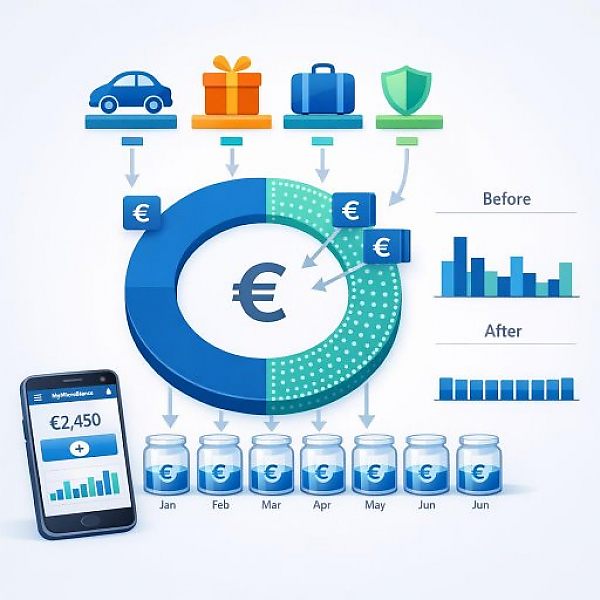
A personal spending rhythm describes how often your recurring expenses are actually paid (for example monthly, quarterly, or annually) and how you can convert those payments into consistent monthly amounts so you can plan and analyze them in your budget as a monthly budget.
Your income often arrives monthly. But many costs occur less frequently. So that you still keep an overview, convert each recurring payment into an average monthly amount. That way, in a monthly overview you can see how much money you really need for each type of expense—even if you only pay it once a year.
| Expense type | Typical payment frequency (actual) | Example total amount per interval | Formula for monthly conversion | Example: monthly budget amount |
|---|---|---|---|---|
| Rent / rent incl. utilities | Monthly | €900 per month | Monthly amount stays the same | €900 per month |
| Electricity installment | Monthly | €80 per month | Monthly amount stays the same | €80 per month |
| Internet / phone | Monthly | €40 per month | Monthly amount stays the same | €40 per month |
| Streaming or music subscription | Monthly | €15 per month | Monthly amount stays the same | €15 per month |
| Broadcasting fee | Quarterly (every 3 months) | €55.00 per quarter | Interval amount / 3 | €55.00 / 3 ≈ €18.33 per month |
| Home contents or personal liability insurance | Annually | €120 per year | Interval amount / 12 | €120 / 12 = €10 per month |
| Auto insurance | Annually or semiannually | €600 per year | Interval amount / 12 | €600 / 12 = €50 per month |
| Vehicle tax | Annually | €240 per year | Interval amount / 12 | €240 / 12 = €20 per month |
| Vacation budget | Annually (planned trip) | €1,200 per year | Interval amount / 12 | €1,200 / 12 = €100 per month |
| Gifts (birthdays, holidays) | Annually (spread throughout the year) | €600 per year | Interval amount / 12 | €600 / 12 = €50 per month |
| Dental checkups / glasses | Annually or every 2 years | €300 per year (average) | Interval amount / 12 | €300 / 12 = €25 per month |
| Car maintenance / inspection | Annually | €400 per year | Interval amount / 12 | €400 / 12 ≈ €33.33 per month |
| Utilities true-up payment (estimate) | Annually | €240 per year (buffer) | Interval amount / 12 | €240 / 12 = €20 per month |
| Membership dues (club, gym) | Monthly or annually | €240 per year | Interval amount / 12 | €240 / 12 = €20 per month |
| School supplies / extra daycare costs | Annually (e.g., start of school) | €300 per year | Interval amount / 12 | €300 / 12 = €25 per month |
Many people underestimate their ongoing costs because they only look at the payments that come out of their account this month. A personal spending rhythm ensures that you consider all recurring expenses—including the ones that show up only rarely.
Converting different spending rhythms is very simple. You only need the amount and the payment interval.
In general, remember: Monthly amount = bill amount ÷ number of months in the payment interval.
In the first step, record all expenses that recur regularly. Check several places for this.
For each item, note:
In the second step, assign each recurring expense to a clear payment interval. The goal is a simple but complete overview.
If you’re unsure, check the last invoice or the contract. It usually clearly states how often it’s billed.
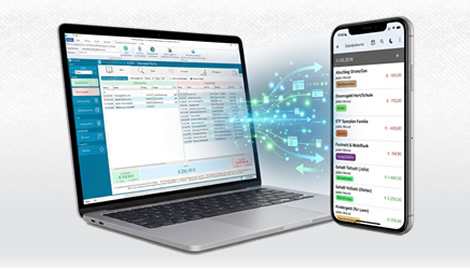
Now convert each amount into a monthly value and enter that monthly value in your budget, for example in MyMicroBalance. This value is your monthly budget amount.
Example:
In software like MyMicroBalance, you can create dedicated categories for this (e.g., vehicle tax, vacation, insurance) and store the monthly amount as a target or budget value.
A personal spending rhythm is not a one-time calculation, but an ongoing process. Use your monthly analysis to check whether your monthly amounts are realistic.
In MyMicroBalance, you can quickly see in the monthly analysis whether your budgets are sufficient. This lets you fine-tune your personal spending rhythm step by step.
Once you’ve captured all recurring expenses and converted them into monthly amounts, you create a stable foundation for your budget.
The clearer your personal spending rhythm is, the easier your financial planning becomes. You no longer have to guess whether you can afford an expense; instead, you can see in your budget how the payment fits into your monthly framework.
Your personal spending rhythm ensures that all recurring expenses—whether monthly or annual—are brought to a consistent monthly basis. You divide each bill by the number of months in the payment interval, resulting in a clear monthly amount. You then store that amount as a monthly budget in your budget, for example in MyMicroBalance. This helps you plan consistently, build reserves for infrequent payments, and keep better control of your finances.

 1
1 2
2 3
3 4
4

