

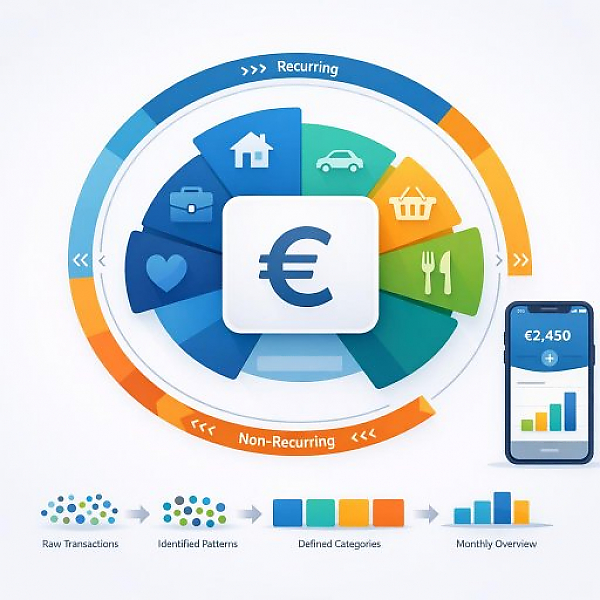
A personal spending type is a clearly defined category you use to classify each expense by its purpose and how regularly it occurs, so your digital budget book like MyMicroBalance can structure and analyze your income and spending in a clear way.
Without fixed spending types, you only see lots of individual transactions. With well-chosen spending types, you can spot patterns:
The key is a consistent categorization logic: the same kind of expense always belongs in the same spending type.
The following table shows typical spending types for a digital budget book. For each type, you’ll see a brief description and common example expenses. Use this list as a framework for your own categories in MyMicroBalance or in your budget spreadsheet.
| Spending type | Short definition | Typical examples |
|---|---|---|
| Housing | All costs for your apartment or house, usually monthly or recurring. | Rent, utilities, electricity, heating, water, trash fees, HOA/condo fees, broadcasting fee, small repairs in the home. |
| Mobility | Expenses for getting around in everyday life and while traveling. | Monthly transit pass, single-ride tickets, gas, car wash, parking fees, bike repair, car sharing, taxi or rideshare trips. |
| Groceries & everyday shopping | All expenses for food, drinks, and ongoing day-to-day necessities. | Supermarket purchases, bakery, beverage store, drugstore items like shampoo, toothpaste, cleaning supplies, basic household items like sponges or trash bags. |
| Health & personal care | Everything related to physical and mental health. | Medications, copays at the doctor or dentist, glasses, contact lenses, physical therapy, out-of-pocket massages, care products, pharmacy purchases. |
| Leisure & hobbies | Expenses for your free time, fun, and personal interests. | Movie theater, restaurant visit, café, sports club, streaming subscriptions, music, gaming, craft supplies, club dues, event tickets. |
| Education & development | Costs for learning, school, college, and personal development. | School books, tuition fees, online courses, professional books, language courses, supplies for school or training, kids’ stationery. |
| Household management & furnishings | Expenses for running your household and larger household purchases. | Home appliances (e.g., vacuum cleaner), kitchen utensils, bedding, towels, furniture, tools, decor, replacement parts for the home. |
| Insurance & long-term planning | Recurring contributions to protect against risks. | Liability insurance, renters/homeowners insurance, disability insurance, auto insurance, private supplemental insurance, other long-term planning contracts. |
| Communication & media | Everything related to phone, internet, and digital services. | Cell phone plan, prepaid top-ups, internet service, landline, online news subscriptions, cloud storage. |
| Kids & family | Expenses specifically for children or other family members you pay for. | Daycare fees, school lunch, allowance, toys, children’s clothing, school trips, music school, holiday childcare, gifts within the family. |
| Gifts & special occasions | Costs for celebrations and gifts outside everyday life. | Birthday gifts, weddings, anniversaries, holiday gifts, celebratory meals, decorations for parties. |
| Miscellaneous & buffer | Irregular or hard-to-classify expenses that occur rarely. | Government fees, fines, impulse purchases, one-time payments, small amounts that don’t fit any other spending type. |
In addition to purpose, the frequency of your payments can also matter. This helps you keep recurring costs on your radar.
You can track this distinction in MyMicroBalance, for example via additional fields, notes, or subcategories. But the main logic remains the classification by the purpose of the expense.
For beginners, too many spending types are confusing. A proven approach is:
More important than the perfect list is that you use your chosen spending types consistently. The same kind of expense should always be assigned to the same type.
These four steps will give you a stable categorization logic for your digital budget book.
This helps you identify the main areas in your life where money flows out regularly.
Your goal is a clear structure that’s easy to remember.
If you’re unsure at the beginning, choose the broader spending type. Overly granular types often create more confusion than value.
Use this monthly review to simplify your structure over time. A simple and stable structure is better than a perfect one you can’t maintain in everyday life.
A personal spending type is the foundation of every digital budget book. It assigns each expense to a clear purpose and a fixed category. With a simple but well-thought-out list of spending types—like the one described in this article—your budget book in MyMicroBalance becomes clear, comparable, and meaningful. This way, you can see exactly where your money goes and manage your finances more intentionally.

 1
1 2
2 3
3 4
4

