

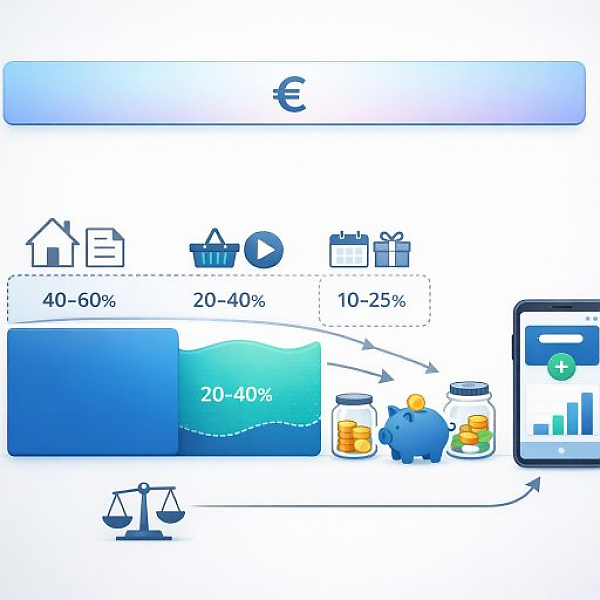
A budget by expense type systematically divides your monthly income into fixed costs, variable costs, and occasional expenses, so you can see exactly which payments are guaranteed to occur and where you can flexibly adjust day to day.
The following table shows a simple master structure for your budget tracker. For each expense type, you’ll see a short explanation, typical examples, and a rough guideline for what percentage of your monthly net income often flows into that group. These values are only guidelines, not strict requirements.
| Expense type | Definition & typical examples | Typical range per month (of net income) |
|---|---|---|
| Fixed costs | Recurring expenses in the same or very similar amount. They usually occur monthly and are hard to change in the short term. Typical examples: Rent or mortgage payment, base electricity charge, internet and phone plan, monthly public transit pass, broadcasting fee, daycare fees, membership dues (e.g., a club), ongoing insurance premiums that are debited monthly. | Often around 40–60% of net income. Note: The lower this share, the more flexibility you have for other areas. |
| Variable costs | Ongoing day-to-day expenses that fluctuate in amount. They occur regularly, but differ each month and are easy to influence. Typical examples: Groceries and drugstore items, lunch in the cafeteria, restaurant visits, leisure and hobbies, streaming subscriptions, clothing, household purchases, small online orders. | Often around 20–40% of net income. This is where your most important levers are if you want to save or reallocate. |
| Occasional expenses | Irregular but foreseeable payments. They don’t occur every month, but can be large. In a budget tracker, they are converted into monthly amounts. Typical examples: Annual insurance payments, vehicle tax, larger repairs, doctor and dental costs (out-of-pocket share), vacations, gifts (birthdays, celebrations), purchases like furniture or electronics. | Often around 10–25% of net income, planned as a monthly set-aside. Ideally, you park these amounts intentionally, e.g., as a separate category or virtual “pot.” |
Before you plan your budget by expense type, you need a clear starting number: your monthly net income. That’s the money you actually have available after taxes and social security contributions.
This value is the upper limit for your spending: fixed, variable, and occasional costs combined must not exceed this amount in the long run.
In the second step, collect all fixed costs that occur reliably and in a similar amount. The goal is a complete list so that no important payment is forgotten.
Now add up all fixed costs. The resulting total shows you how much of your net income is already “allocated.” This part of your budget is difficult to change on short notice.
Next, focus on variable costs. These are typical day-to-day expenses that occur regularly but vary significantly in amount.
For each of these subcategories, set a realistic monthly budget:
The total of all variable costs plus fixed costs must not use up all of your net income yet. There should still be room for occasional expenses.
Finally, you address occasional expenses. They are irregular, but can heavily strain your budget if you don’t plan for them in advance.
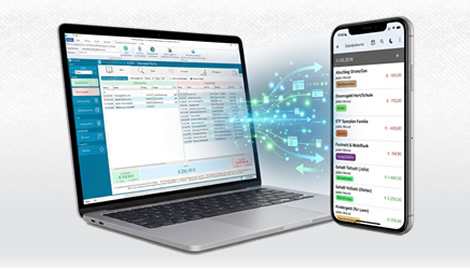
Important: You’re not spending this money right away. You intentionally “park” it, for example as set-aside categories in MyMicroBalance. When the bill or purchase comes later, the money is already accounted for.
To finish, check whether your plan is realistic and fits your income.
Possible outcomes:
So your plan doesn’t just work on paper, a clear structure in your budget tracker helps.
If you consistently sort your budget into fixed, variable, and occasional expenses, you gain a clear overview: you’ll know which payments are definitely coming, where your flexible room is, and which larger costs you need to cushion in advance. That turns your budget tracker into a practical control tool — not just a collection of numbers.

 1
1 2
2 3
3 4
4

