

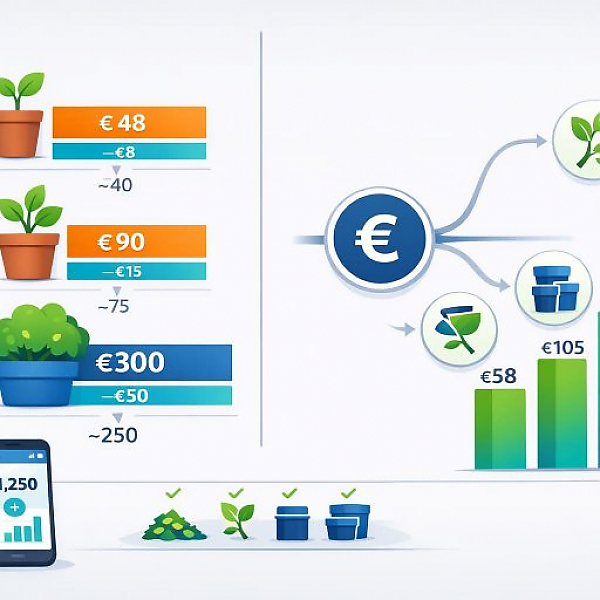
In fall, many balcony and garden owners face the decision: put in the effort for winter protection, or buy new plants in spring? With simple measures, many plants can be saved, or you can grow new plants from cuttings. This analysis uses fictional but realistic average values to show how costs compare between buying replacements versus simple overwintering—and how much you can potentially save.
For the calculation, we distinguish two plant categories:
Three household types are considered (fictional averages):
For overwintering, we assume simple measures: mulch made from leaves/grass clippings (free for many households), insulating pots with cardboard and bubble wrap (one-time, inexpensive materials), propagation by cuttings/division (time investment, low material cost), community sharing (soil, pots, compost — partial savings).
| Household type | Buying replacements (EUR) | Simple overwintering (material costs, EUR) | Estimated savings (EUR) |
|---|---|---|---|
| Students | 8 plants x 6 = 48 | Bubble wrap + cardboard + labels = 8 plus community swapping reduces the need for soil/pots |
~40 EUR (48 - 8) |
| Small household / couple | 15 plants x 6 = 90 | Pot insulation + mulching tool (pro-rated) = 15 | ~75 EUR (90 - 15) |
| Family with a garden | (20 potted x 6) + (10 perennials x 18) = 120 + 180 = 300 | Materials for many pots (bubble wrap, cardboard) 30 + optional wood chips (purchased) 20 = 50 Community sharing/cuttings can replace additional costs |
~250 EUR (300 - 50) |
The figures above assume overwintering succeeds using a simple method. Two levers increase savings:
| Household type | Base savings | + cuttings (plants replaced) | Recalculated savings |
|---|---|---|---|
| Students | ~40 EUR | 3 cuttings -> 3 x 6 = 18 EUR saved | ~58 EUR (40 + 18) |
| Small household / couple | ~75 EUR | 5 cuttings -> 5 x 6 = 30 EUR saved | ~105 EUR (75 + 30) |
| Family with a garden | ~250 EUR | 10 cuttings/divisions -> 6 potted plants x 6 = 36 EUR + 4 perennials x 18 = 72 EUR = 108 EUR saved | ~358 EUR (250 + 108) |
Collect leaves, layer them loosely or shred them briefly, and use them as mulch around plants. A 5–10 cm thick layer protects root balls and saves you from buying pricey wood chips. Tip: collect bags of leaves in fall, shred briefly (using a chipper via swap or neighborhood lending), and spread as needed.
During fall pruning, cut well-preserved, non-flowering shoots to 8–12 cm, remove lower leaves, and place them in water or small pots with light seed-starting mix. A mason jar of water is enough for many species for a few weeks; watch for root development and then pot up. Divide perennials in fall: dig up, split the root ball with a spade, and replant.
Group pots together (place multiple pots tightly next to each other). Outer insulation with cardboard and bubble wrap (attach wrap inside the cardboard) reduces frost damage. Use sheltered locations: along a wall, in a house alcove, an unheated garage/stairwell. Often a thin insulation layer is enough to avoid expensive storage options.
Organize neighborhood swap opportunities for used pots, excess soil, or compost. Once organized, meetups reduce purchasing costs and transport effort. Simple exchange lists via a notice board or messenger app are enough to share materials.
Simple overwintering of balcony and garden plants is, in most cases, significantly cheaper than a full replacement purchase in spring. Even with small material expenses (cardboard boxes, a bit of bubble wrap, possibly purchased wood chips), students, couples, and families can easily save dozens of euros. Cuttings, divisions, and community sharing increase savings even further. If you invest a bit of time and use local resources, you can save money and preserve plant variety over the long term.





 1
1 2
2 3
3 4
4

