22. October 2025 | How-Tow

Shock Ventilation vs. Dehumidifiers in Fall: Which Strategy Actually Saves Households, Families, and Students on Heating and Mold Costs

Shock Ventilation vs. Dehumidifiers in Fall: Which Strategy Actually Saves Households, Families, and Students on Heating and Mold Costs

Quick Summary

In fall, indoor humidity often rises due to shorter days, more cooking, showering, and wet clothes. For most households, proper shock ventilation combined with everyday tactics, hygrometer monitoring, and simple sealing measures is enough. Electric or passive dehumidifiers make sense when relative humidity stays above ~60% long-term, visible mold appears, or there’s no place to dry laundry. In this article, we compare costs, comfort, and practicality for families, students, and budget-conscious households, and provide a hands-on decision checklist.

How Shock Ventilation Works — Fast, Free, Effective

Shock ventilation means: ventilate briefly, forcefully, and completely (3–10 minutes). Cross-ventilation is ideal—opening windows on opposite sides. The goal: quickly replace humid indoor air with drier outdoor air without leaving windows tilted open for hours.

  • When: right after showering, cooking, hanging laundry, or when many people are in the room.
  • How long: 3–10 minutes depending on the temperature difference and window size.
  • Cost: essentially zero upfront; heat losses per ventilation event are usually small (roughly a few cents, depending on the building). A rough estimate: a 10-minute cross-ventilation session can cost heating energy in the range of about €0.05–€0.50 — highly dependent on insulation and outdoor temperature.
  • Pros: fast, no electricity costs, improves air quality (CO2, odors), prevents moisture hotspots when used regularly.
  • Cons: only effective if done correctly; less effective when outdoor air is very humid (e.g., foggy weather).

How Electric and Passive Dehumidifiers Work

There are two categories:

  • Electric devices (compressor or Peltier): pull moisture from the air and condense it into a tank. Power draw for small models is typically 200–500 W, but they don’t run 24/7 at full output.
  • Passive solutions (salt/granules, moisture absorbers): chemical sorbents in bags or containers, cheap upfront, limited capacity, need regular replacement or disposal.

Costs and impact – rough reference values:

  • Purchase price: small electric dehumidifiers about €40–€250; passive sets from €5–€20 (plus refills).
  • Operating costs (electric): depend on usage time. Example: device ~300 W, runs in fall an average of 3–8 hours/day → 0.9–2.4 kWh/day. At an electricity price of €0.35/kWh, that’s ~€0.31–€0.84/day or ~€9–€25/month. Many devices switch off once a target level is reached, so real-world costs can be lower.
  • Effect: dehumidifiers reduce humidity regardless of ventilation behavior — practical if you can’t ventilate often or if outdoor air is also humid.

Quick Comparison: Shock Ventilation vs. Dehumidifier

CriterionShock ventilation & everyday rulesElectric / passive dehumidifying
Upfront cost €0 (optionally a hygrometer €5–€20) €40–€250 (electric), €5–€20 (passive)
Ongoing costs negligible (a few cents per ventilation session) about €5–€30/month electric; passive refills €5–€15/month
Effectiveness with acute moisture very good with correct timing, but dependent on outdoor conditions reliable, even when outdoor air is humid
Convenience requires active behavior convenient, runs automatically
Best for rentals, families, shared apartments with regular use rooms with heavy and/or persistent moisture, rooms that are hard to ventilate

When Which Approach Makes Sense — Decision Aid

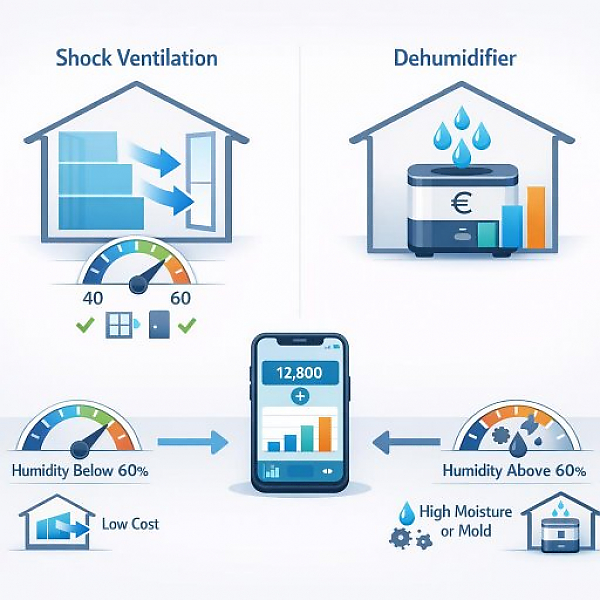
The most important measurement is relative humidity (RH). A good target range is 40–60%:

  • RH <= 60% in most cases: try shock ventilation + everyday rules first.
  • RH consistently > 60% or visible mold/musty odor: consider a dehumidifier and check root causes (leak, missing insulation, broken exhaust fan).

Practical Tips & Seasonal Money-Saving Tips

  • Get a hygrometer (€5–€20) and measure in several spots (bathroom, bedroom, near an exterior wall). Check morning and evening.
  • Shock ventilation: 3–10 minutes after showering/cooking. Ventilate more often with multiple residents.
  • Laundry: if possible, dry outside or in well-ventilated rooms; a small drying rack on the balcony reduces mold risk and saves dryer electricity.
  • Close doors: keep doors closed while showering/drying to avoid spreading moisture through the apartment.
  • Check seals: replacing window and door seals saves heating costs over time and prevents condensation on cold windows.
  • Passive measures: salt/granule containers in closets or small rooms can help short-term (cheap, but low capacity).
  • If there’s mold: clean immediately (e.g., with a mild household cleaner) and fix the cause; have larger infestations professionally assessed — renovation consequences can be expensive (hundreds to thousands of euros).

Decision Checklist by Household Type

Young Families

  • Start: buy a hygrometer, use shock ventilation after routines (cooking, showering), keep doors between living and sleeping areas closed.
  • If kids’ rooms or bedrooms often show >60%: consider a small electric dehumidifier (portable) for the affected rooms.
  • Important: monitor regularly; have mold in children’s rooms professionally evaluated quickly.

Students / Shared Apartment Rooms

  • Usually tight spaces and limited options: a hygrometer is often enough for diagnosis.
  • Shock ventilation: 3–5 minutes before bed and after showering; dry laundry outside the room whenever possible.
  • If moisture persists: an inexpensive passive dehumidifier (granules) or a small electric dehumidifier — weigh cost/benefit (purchase vs. rent, or switching to a better room).

Rentals & Budget Households

  • Start with free measures: shock ventilation, close doors, check window seals, buy a hygrometer.
  • If measures don’t help and the property management isn’t reachable: consider passive absorbers or a shared electric dehumidifier with neighbors in large older buildings.
  • Mold infestation: inform the landlord in writing; document with photos and measurements (hygrometer).

Example Calculation: Is an Electric Dehumidifier Worth It?

Assume: device 300 W, runs an average of 4 hours/day. Power use ≈ 1.2 kWh/day. At €0.35/kWh, that’s ≈ €0.42/day or ≈ €12.6/month. If it can prevent a small mold-related repair (e.g., replacing wallpaper, repainting) costing €200–€500, the device pays off in a few months — provided it reduces humidity effectively.

Final Recommendation

For most households, the combination of regular shock ventilation, everyday rules (laundry, doors, seals), and hygrometer monitoring is the most cost-effective first step. Dehumidifiers (electric or passive) are a useful add-on when humidity is stubbornly high, ventilation is difficult, or there’s an acute mold risk. Weigh purchase and operating costs against potential follow-up costs (renovation, health, comfort) — and document findings in rental situations.


Quick Takeaway Checklist

  • Hygrometer in multiple spots: target 40–60%.
  • Shock ventilation: 3–10 minutes after moisture-heavy activities.
  • Close doors; dry laundry outdoors or in a well-ventilated room when possible.
  • Passive absorbers as a cheap stopgap; electric dehumidifier for persistent >60% or visible mold.
  • If there’s mold: document, inform the landlord, and fix the cause.

Download the Budget Tracker MyMicroBalance for Windows, Android or iOS