

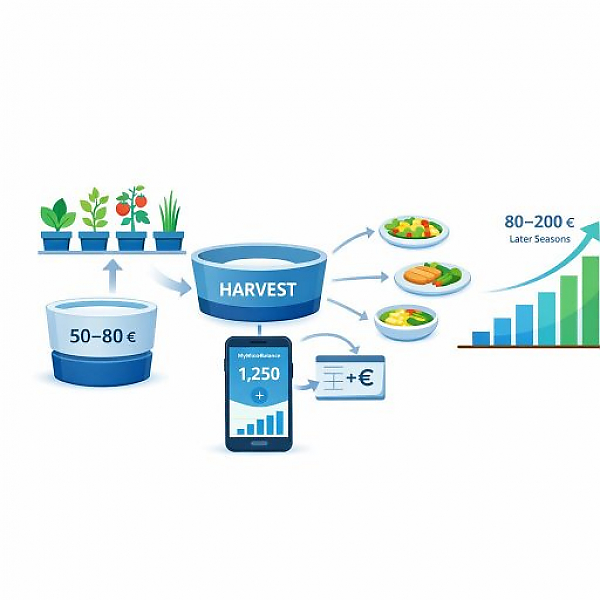
With a small balcony and 3–5 easy vegetables, you can realistically save €80–€200 per season. You’ll need a starting budget of about €50–€80 and you’ll need to use your harvest consistently in your weekly meal plan.
So you can calculate clearly, we’ll use simple, realistic values. Prices are averages from discount and supermarket store brands.
Important: Harvest quantities are conservatively estimated. You may get more, but we’d rather calculate safely. That way you see what’s truly realistic.
The table shows 8 typical balcony plants with: upfront costs, ongoing costs, harvest, supermarket prices, savings, and when your basic setup pays for itself.
| Plant | One-time upfront costs (pot, soil, seeds/seedling) | Ongoing costs per season (water, fertilizer) | Realistically usable harvest per season for the household | Reference price at the supermarket | Value of the harvest at the supermarket | Potential savings per season | Payback on basic setup (when does it pay off?) |
|---|---|---|---|---|---|---|---|
| Cocktail tomatoes (1 large pot, 1 plant) | €20 (€10 pot, €8 soil, €2 seedling) | €3 (water + fertilizer) | approx. 3 kg (spread over 4–5 months) | approx. €4 / 500 g clamshell (discount store brand) | approx. €24 (6 clamshells of 500 g each) | €24 (value) − €3 (ongoing) = €21 | Basic setup (€20) pays for itself in 1–2 seasons |
| Leaf lettuce mix (2 balcony planters) | €25 (2 planters €14, soil €9, seeds €2) | €3 | approx. 10 heads of lettuce (spread out via reseeding) | approx. €1.50 / head (discount store brand) | approx. €15 | €15 − €3 = €12 | Basic setup (€25) pays for itself in 2–3 seasons |
| Radishes (1 planter) | €15 (planter €8, soil €6, seeds €1) | €2 | approx. 4 bunches (sown in several rounds) | approx. €1.20 / bunch | approx. €4.80 | €4.80 − €2 = €2.80 | Financially more of a side item; payback after several seasons |
| Herb mix (3 pots, e.g., basil, parsley, mint) | €18 (3 pots €9, soil €7, seeds/seedlings €2) | €2 | approx. 12 bunches (cut throughout the season) | approx. €1.50 / bunch (fresh herbs) | approx. €18 | €18 − €2 = €16 | Basic setup (€18) pays for itself in 1–2 seasons |
| Bell peppers (sweet) (1 large pot, 1–2 plants) | €22 (pot €10, soil €8, seedlings €4) | €3 | approx. 8–10 peppers | approx. €1.00 / each (mixed varieties) | approx. €8–€10 | €8–€10 − €3 = approx. €5–€7 | Payback after 2–3 seasons |
| Strawberries (balcony planter, 3 plants) | €25 (planter €10, soil €10, seedlings €5) | €3 | approx. 1.5 kg (multiple harvest waves) | approx. €3.50 / 500 g clamshell | approx. €10.50 | €10.50 − €3 = €7.50 | Payback after 2–3 seasons |
| Zucchini (1 large tub, 1 plant) | €22 (tub €12, soil €8, seeds/seedling €2) | €3 | approx. 4–5 kg (many small fruits) | approx. €2.50 / kg | approx. €10–€12.50 | €10–€12.50 − €3 = approx. €7–€9.50 | Payback after 2–3 seasons |
| Chives (1 pot, perennial) | €10 (pot €5, soil €3, seedling/seeds €2) | €1 | approx. 6 bunches per season | approx. €1.00 / bunch | approx. €6 | €6 − €1 = €5 | Payback after 2 seasons, then it’s almost all profit |
If you intentionally choose the high-savings plants, a small starter set could look like this:
You’ll pay roughly:
With conservative estimates, the supermarket equivalent is about €90–€120 per season. Your real savings in the first year are then around €10–€40. In the following years, you already own the pots and planters. Then you can save €60–€120 per season because you’ll mainly be paying for soil refresh, seeds, and fertilizer.
If you later add strawberries or bell peppers, it’s easy to reach €80–€200 in savings per season, depending on balcony size and how consistently you use the harvest.
Treat your balcony like a small project. That way you keep cost control and clearly see what you save.
Your advantage: you immediately see how much money is flowing into the balcony. And later you can offset it against what you didn’t have to buy at the supermarket.
Overcrowded balconies cost a lot and often create stress. For your wallet, a clear, simple start is better.
Recommended starter combo with a savings focus:
Optional add-on:
How you save in practice:
You only truly save money if you actually eat your harvest. Otherwise it’s expensive decor.
How to plan smart:
Your advantage: you intentionally buy less fresh produce “just in case” that later spoils in the fridge. That’s how you turn theoretical savings into real lower spending.
The biggest expense is usually the basic setup. If you use it wisely, your fixed costs drop each year.
This significantly reduces your annual balcony costs. Instead of buying everything new every year, you’ll mainly pay for soil refresh, seeds, and fertilizer. That can turn €70–€80 in start-up costs into just €20–€30 per year.
Many people underestimate how much a balcony garden really saves. If you write it down, you’ll see your return in black and white.
Here’s how:
Example for one month in peak season:
That alone is already €20 saved in a month. Over 4–5 strong months per year, you quickly reach €80–€100. With additional plants like zucchini or strawberries, the amount increases.
You don’t have to start perfectly. What matters is that you start and keep an eye on your spending.
If you follow these steps, your balcony becomes a small, manageable source of savings. You’ll eat fresher, waste less, and you’ll see in your household ledger exactly how your effort pays off in euros.




 1
1 2
2 3
3 4
4

