24. January 2026 | How-Tow

Spring Cleaning for Your Household Budget: How to Save Up to €250 a Month with Clear Cuts

Spring Cleaning for Your Household Budget: How to Save Up to €250 a Month with Clear Cuts

Spring Cleaning for Your Household Budget: Results in 30 Seconds

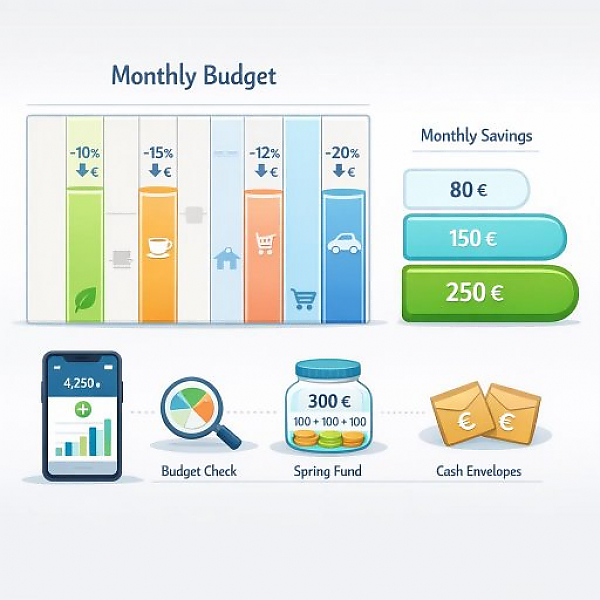
If you deliberately cut 3–4 major spending categories by 10–20%, you can realistically save between €80 (single) and €250 (family) per month—without cutting all the fun.

Master Table: Where You Can Really Save in Spring

The figures in the table are averages. They show typical spending in spring, so you can quickly see where saving is worth it.

CategoryAvg./month SingleAvg./month 2 adultsAvg./month Family (4 people)Smart savings goalSavings SingleSavings 2 adultsSavings FamilyEffortPractical tip (short)
Leisure & outings €120 €180 €250 15% €18 €27 €38 medium Replace 1 expensive outing per month with a free park day.
Garden & balcony €40 €60 €90 25% €10 €15 €23 medium Buy perennials and seedlings instead of pricey decor.
Spring decor €25 €30 €40 50% €13 €15 €20 low Set just 1 small decor budget and use lots of natural materials.
Clothing & shoes €80 €120 €180 20% €16 €24 €36 medium Sort your closet first, then only buy what you truly need.
Groceries & snacks €220 €380 €550 10% €22 €38 €55 medium One weekly meal plan, more store brands, fewer convenience foods.
Public transit & car €90 €150 €220 15% €14 €23 €33 medium Swap 2 trips per week for biking or walking instead of driving.
Household electricity & water €70 €95 €130 10% €7 €10 €13 low Take shorter showers, run full loads, fully power off devices.
Coffee, ice cream & little extras €60 €80 €110 30% €18 €24 €33 low Use weekly cash envelopes; cap coffee-to-go at 2x per week.
Communication & subscriptions €50 €70 €90 20% €10 €14 €18 high Review plans; cancel unused subscriptions and memberships.

Realistic total example: If you tackle only 4 of these areas (e.g., leisure, groceries, little extras, communication), savings of about €80 (single) up to €200–250 (family) per month are very achievable.

Step 1: A 30-Minute Budget Spring Clean

You’ll need: bank statements from the last 3 months (paper or app), a pen or highlight tool. Set a timer for 30 minutes. Then:

  • 1. Download bank statements for the last 3 months or open your banking app.
  • 2. Roughly tag every expense into 8–10 areas:
    • Leisure & outings
    • Garden & balcony
    • Spring decor
    • Clothing & shoes
    • Groceries & snacks
    • Public transit & car
    • Electricity & water
    • Coffee, ice cream & little extras
    • Communication & subscriptions
  • 3. For each category, write down the rough monthly average (a ballpark estimate is fine).
  • 4. Quickly ask: “What happens if I cut 10% here?”
  • 5. Mark only 3–4 categories with the biggest euro amounts. Start only there.

This avoids stress. You don’t have to save everywhere—you focus on the biggest levers.

Step 2: Bundle Seasonal Spending — Your Spring Fund

In spring, many extra expenses hit at once: flowers, grilling, outings. If you don’t plan them, they spill into your regular monthly budget—and things get tight.

Solution: Set up a dedicated spring fund (in your budget tracker or as a sub-account).

  • 1. Ask yourself: How much can you spend on extras for the whole season (e.g., March–May)? Example family: €300 for 3 months.
  • 2. Divide the amount by 3 months. In the example: €100 per month.
  • 3. Pay for everything related to garden, balcony, decor, and spring outings only from this fund.
  • 4. If the fund is empty, push the next purchase to the next month.

This keeps your regular monthly budget stable. You still have fun—just with a clear limit.

Step 3: Recheck Fixed Expenses in Spring

Especially in spring, you can rethink many recurring costs. You’re outside more, the weather is better—and that naturally lowers costs.

Mobility: Public Transit & Car

  • Take 2 trips per week by bike or on foot instead of by car.
  • Carpool to work or to sports.
  • Save on parking fees: park farther away for free and walk a bit.

Realistic savings: €10–30 per month, depending on distance and parking costs.

Communication & Memberships

  • Review your cell and internet plans: are you paying for more data or service than you use?
  • Streaming, music, games, fitness apps: put anything you’ve barely used for 1–2 months on a cut list.
  • Clubs or classes you haven’t attended for months can be canceled or paused.

Realistic savings: €10–30 per month—often with just 1–2 cancellations.

Step 4: Watch the Small Stuff — Snacks, Ice Cream, and Coffee To-Go

Especially in spring, “just real quick” spending grows:

  • One ice cream here, one coffee to-go there.
  • Sweets in the park, a snack on the train, small decor items in a store.

Here’s what that can look like:

  • Coffee to-go 3x per week at €3 each = about €36 per month.
  • Ice cream or a snack 2x per week at €2.50 each = about €20.
  • Spontaneous decor or little extras 1x per week at €5 = about €20.

Total: quickly €70–80 per month—just on little extras.

Simple Weekly Cash-Envelope System

Here’s how to curb these expenses without cutting every treat:

  • 1. Set a weekly limit for snacks, ice cream, and coffee. Example single: €15, family: €30.
  • 2. Withdraw the money in cash and put it in an envelope labeled “Snacks & coffee.”
  • 3. Pay for all spontaneous little purchases only from this envelope.
  • 4. When the money is gone, there are no more impulse buys until next week.

This makes it easy to cut those expenses by 30–50%. That’s often €20–40 per month for singles and up to €60 for families.

Step 5: A Family Rule for Spring Leisure

With kids, spring can get expensive fast: the zoo, petting zoo, indoor playgrounds, ice cream, rides. A clear rule helps everyone.

How to Set Up a Family Leisure Budget

  • 1. Sit down as a family. Explain in simple terms: “We only have amount X per week for leisure.”
  • 2. Set a weekly cap, for example:
    • Small family (2 adults, 1–2 kids): €40–60 per week.
    • Larger family: €60–80 per week.
  • 3. Create a shared wish list:
    • free options (forest, playground, bike ride)
    • low-cost options (pool with discounts, museum with a family ticket)
    • expensive options (theme park, zoo)
  • 4. Plan for each week:
  • One expensive outing = fewer other paid activities.
  • More free options = more money left over, e.g., for one special day per month.
  • 5. Feel free to use cash here too: an envelope labeled “Family leisure week X.”

This teaches kids along the way: money is limited, and you have to choose. You stay in control of costs.

Practical Savings Ideas by Category (Ready to Implement)

Leisure & outings

  • Look for free or very low-cost destinations: forests, lakes, playgrounds, city festivals.
  • Bring your own snacks and drinks instead of pricey concession stands.
  • Plan 1 “high-budget day” per month and keep the rest more affordable.

Garden & balcony

  • Divide and swap plants with neighbors or friends.
  • Buy perennials that come back every year.
  • Decor from nature: stones, branches, blossoms instead of expensive figurines.

Spring decor

  • Set a maximum of 1 small decor budget per season, e.g., €20–30.
  • Create a decor box and reuse items instead of buying everything new each year.
  • DIY with kids: garlands, painted jars, painted stones.

Clothing & shoes

  • Go through your closet completely: declutter what’s too small or damaged.
  • Only replace what’s truly missing (e.g., a jacket, a pair of sneakers).
  • Use thrift stores or flea markets, especially for kids.

Groceries & snacks

  • Write a meal plan once a week.
  • Shop with a list and, ideally, go when you’re not hungry.
  • More fresh seasonal produce and store brands, fewer ready-made meals.
  • Prep snacks for outings at home (granola bars, sandwiches, water).

Electricity & water

  • Only run full loads of laundry.
  • Take short showers instead of long baths.
  • Turn devices fully off—don’t leave them on standby.
  • In spring, air out rooms more often and heat less; don’t overheat your home.

Start Today — in 3 Steps

  • 1. Take 30 minutes for your budget spring clean and pick your 3–4 biggest categories.
  • 2. Set a clear amount you want to cut in each of those categories by at least 10–20%.
  • 3. Set up at least 2 cash envelopes: “Snacks & coffee” and “Family leisure” or “Spring fund.”

You don’t have to start perfectly. If you begin today, you can already feel the relief in your account next month—without going to extremes.

Download the Budget Tracker MyMicroBalance for Windows, Android or iOS