

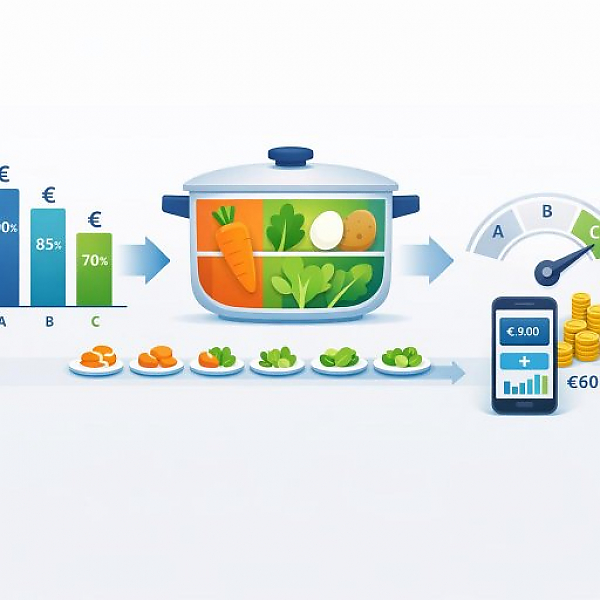
If in spring you focus mainly on seasonal vegetables and cook more at home, you’ll save an average of 15–30% on your grocery costs. Depending on your household, that’s about €60–200 per month—without eating worse.
In spring there are many inexpensive products. You pay less because supply is high and harvests are plentiful. Typical budget-friendly spring ingredients include:
If you plan around these products and use them more often, your costs go down—especially if you replace pricey ready-made meals and last-minute delivery orders.
The following table shows three typical weekly models:
All figures are realistic averages for spring. Costs obviously depend on where you live and your preferences, but the difference is clear.
| Household & model | Typical eating habits (spring) | Average weekly cost | Estimated monthly cost (4 weeks) | Potential savings vs. Model A |
|---|---|---|---|---|
| Single – A: Ready-made & convenience | Lots of prepared meals, snacks, delivery 2–3x | €80 | €320 | – |
| Single – B: Mixed | About 50% home-cooked, 50% convenience | €65 | €260 | approx. €60 per month |
| Single – C: Seasonal-fresh | Mostly home-cooked with spring vegetables | €55 | €220 | approx. €100 per month |
| Couple – A: Ready-made & convenience | Lots of prepared meals, snacks, delivery 2–3x | €140 | €560 | – |
| Couple – B: Mixed | About 50% home-cooked, 50% convenience | €115 | €460 | approx. €100 per month |
| Couple – C: Seasonal-fresh | Mostly home-cooked with spring vegetables | €95 | €380 | approx. €180 per month |
| Family (4 people) – A: Ready-made & convenience | Lots of prepared meals, snacks, delivery 2–3x | €220 | €880 | – |
| Family (4 people) – B: Mixed | About 50% home-cooked, 50% convenience | €185 | €740 | approx. €140 per month |
| Family (4 people) – C: Seasonal-fresh | Mostly home-cooked with spring vegetables | €155 | €620 | approx. €260 per month |
Key takeaway: If you switch from Model A to Model C, you’ll realistically save about 15–30%. That’s exactly what you can make visible in your budget tracker.
With planning, you can see ahead of time what you’re going to spend—so you make good decisions. Set aside one fixed hour every week, for example Sunday evening.
Here’s how:
Your benefit: Even before shopping, you can see whether you’ll end up closer to Model A, B, or C. That lets you make targeted swaps: one pricey prepared meal out, one seasonal dish in.
If you record every meal with estimated costs, you’ll quickly see your week moving toward Model C—and your savings growing.
Many households throw away a lot of money. The reason: open packages, partially used bunches, old eggs. You can reduce this significantly by deliberately planning to reuse a few staple ingredients.
For one week, choose for example these 5 inexpensive spring staples:
Then plan multiple meals that use those ingredients. That way you use everything up instead of throwing it away.
Enter these meals with dates in your budget tracker. Note:
Your benefit: You’ll see in black and white how much less you’re throwing away. That noticeably reduces your real weekly costs—often by €10–20 for families.
Delivery food and prepared meals are convenient—but expensive. You can save a lot by replacing just two of these meals per week.
Here’s how to do it:
Log each of these meals directly in your budget tracker:
Your benefit: You immediately see how individual decisions affect your monthly budget—so you stay motivated.
These dishes are simple, inexpensive, and use your staple ingredients—automatically moving you toward Model C in the table.
With a small system, you can quickly see whether you’re living closer to Model A, B, or C. That helps you classify yourself realistically and make targeted changes.
How to track your index for four weeks:
At the end of each week, count:
Then compare with the master table above. Where do your weekly costs fall—closer to Model A, B, or C? That also shows how much more you could save if you move step by step further toward Model C.
Use the table as a target picture, not pressure. You don’t have to be perfect. Every swapped meal helps.
If you’re currently at Single Model A (about €80 per week) and move toward Model C (about €55 per week), you’ll end up saving around €100 per month. For families, the table shows an average of up to €260 per month.
Print this list or write it at the front of your budget tracker:
You don’t have to change everything at once. But every intentional decision in your spring kitchen lowers your costs. With the combination of a budget tracker, a planning hour, and seasonal ingredients, you make your personal savings potential visible—and realistically achieve savings of 15–30% on your grocery budget.



 1
1 2
2 3
3 4
4

