19. April 2026 | How-Tow

Spring Energy Costs in Everyday Life: How to Save €15–€60 per Month Depending on Household Size

Spring Energy Costs in Everyday Life: How to Save €15–€60 per Month Depending on Household Size

Spring Energy Costs in Everyday Life: What’s Realistically Possible Right Now

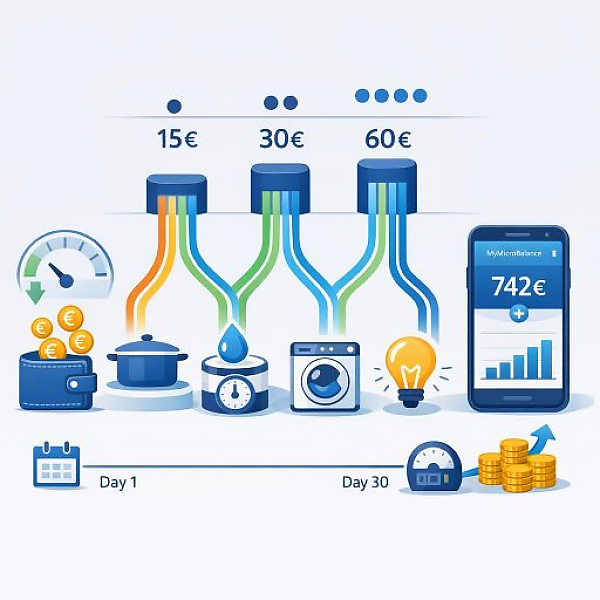
If you change your behavior in spring when it comes to cooking, laundry, lighting, standby power, and hot water, you can save around €15–€60 per month depending on your household size. You don’t need any new appliances—just new habits.

In this guide, you’ll first see an overview with concrete euro amounts. After that, you’ll get simple step-by-step tips you can start today.

Master Table: How Much Can You Really Save in Spring?

The following data simulation shows typical savings assuming an electricity price of 35 cents per kWh and hot water heated with electricity. These are realistic averages—not extreme cases.

Household type Measure Current usage New spring usage kWh saved / month (approx.) Euros saved / month (approx.) Total savings per household across all 5 measures
Single Wash at 30°C instead of 60°C 8 loads/month, mostly 60°C 8 loads/month, mostly 30–40°C 7 kWh €2.50 approx. €15 / month
Single Shorter showers (5 instead of 10 minutes, 1×/day) 10 min. warm shower/day 5 min. warm shower/day 35 kWh €12.30
Single Lighting: more daylight, use LEDs consistently 4 hrs artificial light/day 2 hrs artificial light/day 6 kWh €2.10
Single Turn off standby devices completely TV, router, console, PC always on standby Power strips with switches, off at night 6 kWh €2.10
Single Cook efficiently: lid, residual heat, electric kettle Stovetop often without a lid, lots of preheating Cook with lid, hardly any preheating, use kettle 5 kWh €1.75
Couple Wash at 30°C instead of 60°C 12 loads/month, often 60°C 12 loads/month, mostly 30–40°C 11 kWh €3.85 approx. €30 / month
Couple Shorter showers (5 instead of 10 minutes, 2×/day total) 2× 10 min. warm shower/day 2× 5 min. warm shower/day 70 kWh €24.50
Couple Lighting: more daylight, use LEDs consistently 5 hrs artificial light/day 3 hrs artificial light/day 10 kWh €3.50
Couple Turn off standby devices completely 2 TVs, router, console, PC always on standby Power strips with switches, off at night 10 kWh €3.50
Couple Cook efficiently: lid, residual heat, electric kettle Stove/oven often without a lid, lots of preheating Cook with lid, hardly any preheating, use kettle 8 kWh €2.80
Family (2 adults, 2 kids) Wash at 30°C instead of 60°C 20 loads/month, often 60°C 20 loads/month, mostly 30–40°C 18 kWh €6.30 approx. €60 / month
Family (2 adults, 2 kids) Shorter showers (5 instead of 10 minutes each) 4× 10 min. warm shower/day 4× 5 min. warm shower/day 140 kWh €49.00
Family (2 adults, 2 kids) Lighting: more daylight, use LEDs consistently 6 hrs artificial light/day 4 hrs artificial light/day 16 kWh €5.60
Family (2 adults, 2 kids) Turn off standby devices completely Multiple TVs, router, console, PCs, speakers on standby Power strips with switches, off at night and when away 16 kWh €5.60
Family (2 adults, 2 kids) Cook efficiently: lid, residual heat, electric kettle Stove/oven frequently, little planning Batch cooking, use a lid, use residual heat, electric kettle 12 kWh €4.20

All values are estimates. Your actual number depends on your rate plan, your appliances, and your behavior. But you can see: Even small changes add up to noticeable amounts.

Step 1: Your Mini Energy Diary in Your Household Budget

Before you change anything, take a close look. That’s how you find your biggest savings levers.

  • Grab a simple notebook or your household budget book.
  • Observe your daily routine for 7 days.
  • Write down the time and duration of:
    • Cooking (stove, oven)
    • Washing (washing machine, dishwasher)
    • Showering (hot water)
    • Media use (TV, PC, console, streaming)
    • Lighting (roughly: how many hours are lights on?)
  • Afterward, highlight: Where is the most energy going—cooking, hot water, or media?
  • Important: Estimating is enough. It doesn’t have to be perfect.

Your benefit: You’ll see in black and white where you use the most electricity and hot water. That’s exactly where you’ll save the most money later.

Step 2: Plan Your Personal “Spring Switch”

Now set a fixed start date. That’s how a good intention becomes a real habit.

  • Choose a clear day, such as the 1st or 15th of the month.
  • Write down: “Starting on this day, I’m changing my energy use.”
  • Put a note on the fridge with 5 points:
    • Laundry: mostly 30–40°C instead of 60°C
    • Showers: max. 5 minutes, turn off water while soaping up
    • Standby: switch off power strips when I don’t need them
    • Cooking: use a lid, less preheating, residual heat
    • Lighting: use more daylight
  • Ask everyone in the household: “Will you join in?”

Your benefit: A fixed day makes the switch clear and tangible. You’ll be reminded of it every day.

Step 3: Cooking and Baking — Save with Lids and Planning

Cooking and baking can quickly use a lot of electricity. With a few simple tricks, you can noticeably reduce this part.

  • Always cook with a lid
    • Put the lid on: water boils faster.
    • You need less energy and save a little every day.
  • Electric kettle instead of the stovetop
    • Heat water for pasta, tea, or coffee in the kettle first.
    • Then pour it into the pot. This is often cheaper than the stove.
  • Use residual heat
    • Turn off the stove and oven 5–10 minutes earlier.
    • The remaining heat is usually enough to finish cooking.
  • Skip preheating more often
    • For many dishes, you can use the oven without lengthy preheating.
    • Quickly check the recipe. If it doesn’t explicitly require it, skip preheating.
  • Batch your baking
    • Bake bread, pizza, or cake back-to-back.
    • This makes better use of the hot oven and saves on heat-up cycles.

Your benefit: These changes take almost no extra time. Still, you’ll cut your cooking costs month after month.

Step 4: Laundry in Spring — Colder, Fuller, Less Often

Washing machines and dishwashers often run on autopilot. In spring, you can save a lot here—without getting anything less clean.

  • Lower the temperature
    • Switch standard loads from 60°C to 30–40°C.
    • Many modern detergents work well at lower temperatures.
    • Only towels, bedding, or heavily soiled laundry need higher settings.
  • Always fill the machine well
    • Fill the drum so you can still fit one hand on top of the laundry.
    • Half-empty loads use nearly as much electricity as full ones.
  • Use eco programs
    • If available, choose the savings or eco program.
    • It takes longer, but often uses significantly less energy.
  • Put the dryer into “spring pause mode”
    • Use a drying rack or clothesline as often as possible.
    • In spring, laundry dries faster—especially outdoors.
    • A clothes dryer uses a lot of electricity. Every load you skip saves money.

Your benefit: With lower temperatures and full loads, you’ll save a few euros per month as a single—but as a family you can quickly reach double-digit monthly savings.

Step 5: Lighting — Maximize Daylight

In spring, it stays light longer. That’s your natural, free “energy saver.”

  • Shift activities into daylight hours
    • Move reading, studying, homework, and remote work to brighter hours.
    • This means you’ll need fewer lamps in the evening.
  • Turn lights on and off consciously
    • Do a quick walk-through in the morning: where are lights still on unnecessarily?
    • Train the habit: “Last person out turns off the light.”
  • Pay attention to efficient bulbs
    • If you still have older, power-hungry bulbs, plan to switch to efficient options over time.
    • Start with the most-used rooms (kitchen, living room).
  • Put your workspace near a window
    • Move your desk or study spot closer to the window.
    • It’s easier on your eyes, and you often won’t need extra light during the day.

Your benefit: More daylight makes you feel more awake. At the same time, your electricity use drops almost automatically.

Step 6: Standby Devices — Small Switches, Big Impact

Devices in standby mode still use energy—even when you’re not using them. It adds up quietly.

  • Use power strips with switches
    • Plug your TV, console, sound system, and similar devices into a power strip with a switch.
    • Switch the strip off when you go to sleep or leave the house.
  • Unplug chargers
    • Phone, tablet, or laptop chargers still draw a bit of power, even without a device connected.
    • Unplug them once the battery is full.
  • Use older devices intentionally
    • Older TVs, receivers, or consoles often use more power in standby.
    • Be especially consistent about turning these completely off.
  • Set a household rule
    • Agree on: “Whoever leaves the living room last switches the strip off.”
    • Visible timers or post-its help, especially in the first few weeks.

Your benefit: You’ll quietly save a few euros every month—without missing anything in daily life.

Step 7: Hot Water — Save Most in the Shower

Hot water is often one of the biggest cost drivers—especially for showering.

  • Shower instead of bathing
    • A full bath uses much more hot water than a short shower.
    • If you switch from baths to showers, you’ll save a lot of energy.
  • Cut shower time in half
    • Set a goal: max. 5 minutes per shower.
    • Use a simple kitchen timer or your phone alarm.
    • Turn the water off briefly while soaping up.
  • Only as warm as necessary
    • Don’t automatically turn the handle all the way to hot.
    • Find the lowest temperature that still feels comfortable.
  • Set fixed “saving rules” for kids
    • Explain it in an easy way: “A shower should be as short as a favorite song.”
    • Make it a small game: whoever finishes first wins.

Your benefit: As a couple or family, this is your biggest lever. Every minute less of hot water saves real money.

Step 8: After 30 Days — Check Meters and Adjust Your Budget

After a month, you’ll see how much you’re really saving. That makes your effort visible.

  • Write down meter readings
    • Once a month, record your electricity meter and—if available—your hot water meter reading.
    • Use the same day each month, such as always the 1st.
  • Compare to the previous month
    • Check: how many kWh did you use last month? How many this month?
    • Multiply the difference by your electricity price (e.g., €0.35 per kWh).
    • That shows your real savings in euros.
  • Adjust your household budget
    • If, for example, you spend €30 less per month on energy, plan that amount intentionally.
    • You can:
      • pay down debt faster
      • set money aside for emergencies
      • budget a small extra for family or hobbies
  • Make your saving success visible
    • In your budget book, note: “Saved this month through behavior changes: XX €”.
    • That motivates you and everyone you live with to keep going.

Your benefit: You’ll see exactly how your new habits impact your money. That way, saving isn’t just a feeling—it’s a number.

Conclusion: 5 Habits That Immediately Relieve Your Spring Budget

  • You change no appliances, only your behavior.
  • You focus on: cooking, laundry, lighting, standby power, hot water.
  • Depending on household size, realistic savings are:
    • Single: about €15 per month
    • Couple: about €30 per month
    • Family with 2 kids: about €60 per month
  • With a mini energy diary, a fixed spring start date, and a simple check after 30 days, you’ll have your costs under control.

You can start today. Every small change counts—and step by step, it will lighten your monthly budget.

Download the Budget Tracker MyMicroBalance for Windows, Android or iOS