04. February 2026 | How-Tow

Spring Rides Cost Check: How Much Money You Save by Biking Instead of Driving

Spring Rides Cost Check: How Much Money You Save by Biking Instead of Driving

Spring Rides Cost Check: Your Quick Answer

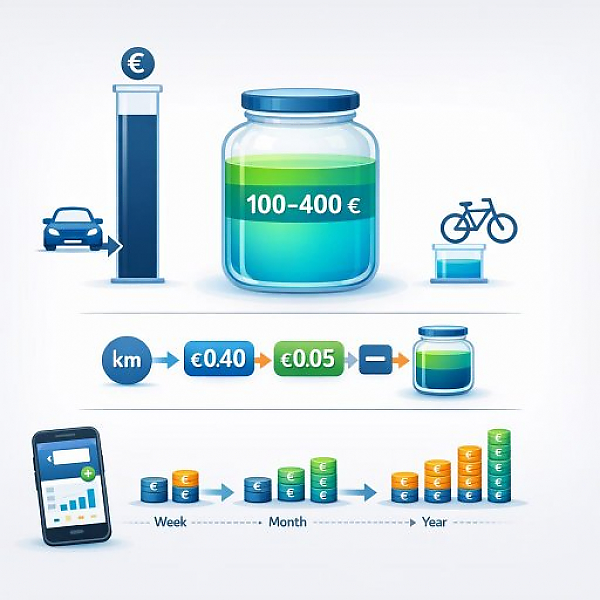
If you consistently shift everyday trips of up to about 10–15 km from your car to your bike, a realistic €100–€400 in savings per year is possible depending on distance and frequency—simply by using a different mode of transportation, without driving less overall.

How We Calculate the Costs of a Car vs. a Bike

To compare honestly, we need simple but realistic assumptions. The numbers are averages. Your actual figures may vary. They’re meant as guidance.

  • Car cost per km: We use €0.40 per km (fuel, wear and tear, repairs, prorated insurance and taxes).
  • Bike cost per km: We use €0.05 per km (purchase spread over several years + maintenance).
  • Workdays: For commuting routes, we assume 20 commute days per month.
  • Round trip: The daily distance is always outbound and return combined.

If you use your own car, your true cost per km is often even higher. With these conservative values, the savings are estimated on the cautious side.

Master Table: Car vs. Bike — What You Save per Month and per Year

The table shows typical everyday distances: short trips around town and commuting routes to work or training. You can see at a glance how much you can save by biking.

Distance per day (round trip) Trips per month Total km per month Car cost per km Car cost per month Car cost per year Bike cost per km Bike cost per month Bike cost per year Savings per month Savings per year
3 km (e.g., a short grocery run) 20 60 km €0.40 €24.00 €288.00 €0.05 €3.00 €36.00 €21.00 €252.00
5 km (e.g., daycare, school, short commute) 20 100 km €0.40 €40.00 €480.00 €0.05 €5.00 €60.00 €35.00 €420.00
10 km (typical commute) 20 200 km €0.40 €80.00 €960.00 €0.05 €10.00 €120.00 €70.00 €840.00
15 km (upper end of what makes sense for biking) 20 300 km €0.40 €120.00 €1,440.00 €0.05 €15.00 €180.00 €105.00 €1,260.00

Important: You don’t have to switch every trip. Even if you shift only part of your routes to biking, you’ll still get a noticeable amount back. For example: If, from the 10 km per day, you bike only half the days, you still save about €35 per month.

Step 1: Track a Typical Week in Your Budget Notebook

Before you start, you need an overview. This makes it easy to find your best saving routes.

  • Use your budget notebook or a simple list.
  • For 7 days, write down every car trip under 15 km (round trip).
  • Add:
    • Start and destination (e.g., home – supermarket)
    • Estimated round-trip distance (e.g., 4 km)
    • Purpose (shopping, work, leisure, school, etc.)
  • Mark every route you can realistically manage by bike.
    • Short trips around town are usually very doable.
    • Distances up to 10–15 km are possible for many people, at least on some days.

Your advantage: You’ll see in black and white where your savings potential is. Often it’s many small trips that add up to big costs.

Step 2: Calculate Your Personal Savings

Now calculate using your real routes. That way you’ll see how much money is realistically on the table for you.

  • Add up all the kilometers you can realistically bike per year.
    • Example: 5 km per day, 3 days per week, 40 weeks = 5 × 3 × 40 = 600 km per year.
  • Multiply those annual kilometers by a conservative car rate, e.g., €0.40 per km.
    • Example: 600 km × €0.40 = €240 in car costs.
  • Roughly calculate your bike costs:
    • If you already have a bike and only pay for some maintenance, you can assume about €0.05 per km.
    • Example: 600 km × €0.05 = €30 in bike costs.
  • Your savings are the difference:
    • From the example: €240 – €30 = €210 in savings per year.

You can calculate this right away with a calculator or in a simple spreadsheet. That gives you your very personal savings target.

Step 3: Start a 4‑Week Test with Fixed Bike Days

Instead of changing everything at once, start small but commit. That makes saving easier.

  • Pick 3 fixed days per week when you’ll use your bike for certain trips.
    • Example: Monday, Wednesday, Friday for your commute.
    • Or: Tuesday and Thursday for shopping and errands.
  • Put these days in your calendar. Treat them like an appointment.
  • Each week, record in your budget notebook:
    • When would you otherwise have driven?
    • How many kilometers did you bike?
    • How much did you actually save on gas? (or how much longer does a tank last now?)
  • Write down the estimated savings per week.
    • Example: You estimate that your bike rides mean you buy €10 less gas per week.
    • After 4 weeks, that’s already €40.

Your advantage: After just one month, you’ll see a real amount. That motivates you to keep going and maybe shift one more route to biking.

Step 4: Budget a Small Maintenance Amount for Your Bike

So you’re not surprised by an unexpected bill, plan your bike costs intentionally.

  • Set a monthly maintenance budget, for example €5–€10.
  • Record this budget in your budget notebook as its own category, e.g., “Bike.”
  • Actually set the money aside, for example in a sub-account or a labeled cash envelope.
  • Use the budget for:
    • Small repairs (e.g., tube, brake pads).
    • Annual tune-up.
    • Basic care (oil, lights, reflectors).

Your advantage: Unexpected expenses won’t blow up your monthly budget. You stay in control and still don’t have to switch back to driving.

Step 5: Connect Mobility with Other Savings Goals

With a bike, you don’t just save on car costs. You can also save on leisure and health at the same time.

  • Plan free outings by bike.
    • Examples: Ride to the lake, to a park, into the woods.
    • You save on admission fees and expensive leisure activities.
  • Use your bike to visit friends or family instead of driving.
  • Track separately in your budget notebook:
    • Saved transportation costs (no car, no ticket).
    • Saved leisure costs (no expensive event, restaurant, or similar).
  • Give your savings a name.
    • For example: “Bike vacation fund” or “Bike emergency fund.”
    • At the end of the month, intentionally transfer the estimated amount to your savings goal.

Your advantage: You quickly see what your choice to drive less is paying for. That makes it easier to stick with it.

How to Put the Tips into Action Today

  • Today: Recall the routes from the last few days and estimate the kilometers.
  • This week: Keep a precise 7-day trip log in your budget notebook.
  • Next week: Choose your 3 fixed bike days and start the 4‑week test.
  • Starting now: Transfer or note each estimated saving—such as €5–€10 per week—into your bike savings pot.

If you start now, you’ll make the most of spring. You’ll move more, gain freedom—and month after month, you’ll get real amounts back that would otherwise disappear into your car.

Download the Budget Tracker MyMicroBalance for Windows, Android or iOS