

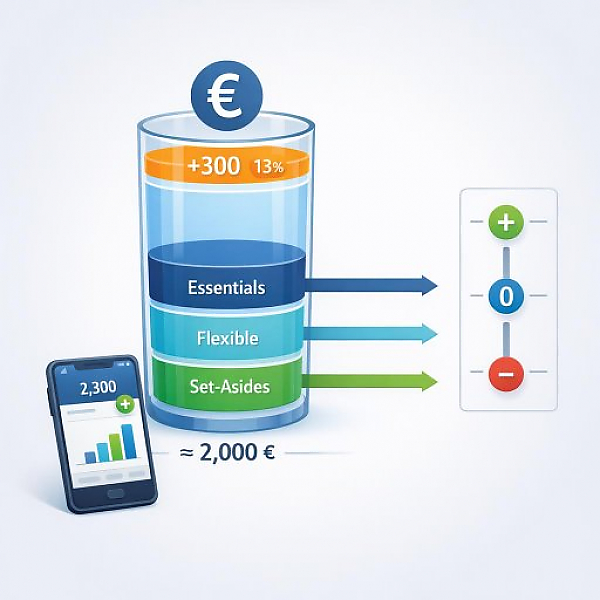
A budget surplus is the amount left over when you subtract all expenses from your total income over a certain period (for example, a month). If the result is positive, you have a surplus; if it’s zero, your income and expenses are balanced; if it’s negative, you have a deficit.
In the sample table below, you’ll see a simple monthly calculation with €2,300 in net income. Expenses are divided into three groups: essential expenses, flexible expenses, and set-asides. At the end, you can see at a glance whether you have a surplus, break-even, or a deficit—and how large the surplus is relative to your income.
| Monthly example | Amount in € | Brief explanation |
|---|---|---|
| Total income | 2,300 | Household net income for the month |
| Essential expenses (e.g., rent, electricity, internet) | 1,200 | Required expenses that occur regularly and are hard to avoid |
| Flexible expenses (e.g., shopping, leisure, dining out) | 600 | Expenses you can adjust each month |
| Set-asides / goals (e.g., emergency fund, vacation budget) | 200 | Money you intentionally set aside |
| Total expenses | 2,000 | Sum of essential expenses, flexible expenses, and set-asides |
| Result: Budget surplus (income minus expenses) | +300 | €2,300 income minus €2,000 expenses = €300 surplus |
| Surplus as % of income | 13% | €300 divided by €2,300 ≈ 13% of income remains |
In this example, you have a budget surplus of €300. That’s about 13% of your monthly income.
In general, there are three outcomes when you calculate income minus expenses:
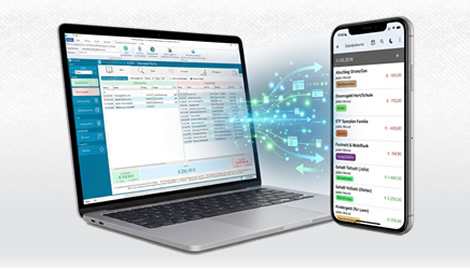
A digital household budget like MyMicroBalance helps you calculate and monitor your budget surplus on a regular basis. Here’s how to proceed step by step:
Your budget surplus is a simple but highly informative number. It shows, in a single figure, whether your lifestyle and regular obligations fit your income. A stable or growing surplus gives you more room for set-asides, goals, and unexpected expenses. A long-term deficit, on the other hand, is a warning sign and indicates that you should take a closer look at your spending structure.
With a clear household budget like MyMicroBalance, you can keep an eye on this key metric at all times and make informed day-to-day decisions.

 1
1 2
2 3
3 4
4

