24. February 2026 | How-Tow

What Is a Personal Budget Plan? A Simple Definition With a Step-by-Step Guide for Your Digital Household Budget

What Is a Personal Budget Plan? A Simple Definition With a Step-by-Step Guide for Your Digital Household Budget

What is a personal budget plan?

A personal budget plan is a planned allocation of your monthly income across fixed spending categories, so you can see at any time how much money is available per month for each category and spot deviations early.

Key terms: The building blocks every budget plan needs

For a budget plan to be easy to understand and useful, a few basic terms should be clear.

  • Income: All the money you receive in a month. For example, wages, pension payments, or other regular payments. In most cases, what matters is net income — the amount after taxes and social security contributions.
  • Budget: A budget is a planned amount of money for a specific purpose or category. You decide in advance: this is the maximum I want to spend.
  • Category: A category is a type of expense. For example, “Housing,” “Groceries,” or “Leisure.” Every expense is assigned to a category.
  • Reserve: A reserve is money you intentionally set aside. You don’t spend it right away. It’s a cushion for later expenses — for example, repairs, vacation, or emergencies.

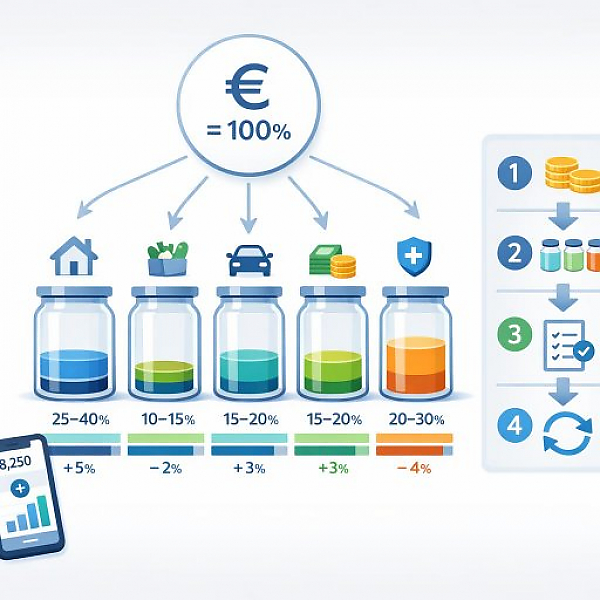
Your personal budget plan connects these concepts: you take your income, split it into budgets, assign those budgets to categories, and also build reserves within them.

Typical budget categories with simple rule-of-thumb targets

Every household is different. Still, common categories and rough guidelines help you get started. Below are examples. They are only reference points, not rules.

  • Housing (rent, loan payment, utilities): often around 25–40% of net income.
  • Groceries & household (shopping, drugstore items, cleaning supplies): often around 10–20%.
  • Transportation (public transit, car, fuel, bike, insurance): around 5–15%.
  • Health (medications, copays, glasses, preventive care): around 3–8%.
  • Communication & media (internet, phone, streaming, newspaper): around 3–8%.
  • Leisure & hobbies (going out, sports, clubs, subscriptions): around 5–15%.
  • Clothing & shoes: often 2–7% (often not the same every month — better viewed as a yearly average).
  • Reserves & savings share (cushion, reserves for larger expenses): as much as possible, for example 5–20% or a fixed dollar amount.
  • Special expenses (gifts, repairs, one-time bills): flexible share, usually covered from reserves.

Instead of percentages, you can also work directly with dollar amounts. Example: With $2,000 in net income, you plan $700 for housing, $300 for groceries, $200 for transportation, and so on. The important thing is that all amounts together add up to no more than your income.

Example: Planned budget vs. actual spending in a month

The following table shows a simple sample month with a planned budget and actual spending. This demonstrates how a personal budget plan and tracking in a household budget tool work together.

Category Planned budget (euros) Actual spending (euros) Difference (euros) Comment
Housing 700 700 0 Fixed costs like rent stayed on plan.
Groceries & household 300 340 -40 Several larger shopping trips, budget slightly exceeded.
Transportation 200 180 +20 Fewer trips, a small buffer built up.
Health 80 50 +30 Planned doctor appointments postponed, money left over.
Leisure & hobbies 200 260 -60 Spontaneous concert visit, clear overage.
Reserves & savings share 300 260 -40 Due to high leisure spending, less was set aside.

In this example, you can see: the sum of the planned budgets matches the income. Deviations become visible. That is the core benefit of a budget plan in a digital household budget tool: you can see where you want to make adjustments.

From your first budget plan to ongoing tracking in a digital household budget tool

A personal budget plan is most effective when you connect it to a digital household budget tool — for example, MyMicroBalance. That way, planning and reality live in one place.

Step 1: Record your monthly net income

  • Determine your monthly net income. This is the amount that actually lands in your account.
  • If you have multiple income sources (e.g., salary and a side job), add them all together.
  • In your digital household budget tool like MyMicroBalance, create one or more income entries and mark them as recurring income if they are similar each month.
  • Remember the total. It is your upper limit for all budget amounts in that month.

Step 2: Set up main categories as budget buckets with amounts

  • Choose 5–8 main categories, for example:
    • Housing
    • Groceries & household
    • Transportation
    • Health
    • Communication & media
    • Leisure & hobbies
    • Reserves & savings share
  • Create these categories in your household budget tool as budget buckets. In MyMicroBalance, you can store a planned monthly amount for each category.
  • Use the guidelines above or your own experience. Example: With $2,000 net income, you might plan $700 for housing, $300 for groceries, $200 for transportation, etc.
  • Finally, check: the sum of all planned budgets must not exceed your net income.

Step 3: Consistently assign every expense to a category

  • Enter every expense promptly in your digital household budget tool. The closer to the payment date, the more accurate your overview will be.
  • Assign each expense to an appropriate category. For example:
    • Grocery store purchase → Groceries & household
    • Transit ticket, fuel → Transportation
    • Rent, utilities → Housing
    • Movie theater, restaurant → Leisure & hobbies
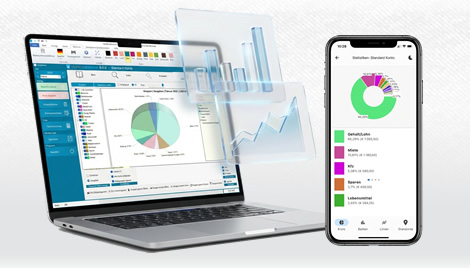
  • In MyMicroBalance, use the category reports. This lets you see at any time how much of your planned budget has already been used per category.
  • For instance, review once a week: where does each category stand compared to its budget?

Step 4: At the end of the month, flag deviations and adjust the budget

  • At month end, take stock: for each category, compare the planned budget with actual spending. The structure matches the sample table above.
  • Flag categories with significant overspending (negative difference) and with larger remaining amounts (positive difference).
  • For each noticeable deviation, consider:
    • Was the overage a one-time event (e.g., a special occasion)?
    • Or do you spend regularly more in this category than planned?
    • Can you realistically cut spending in other categories to offset this overspending?
  • Then adjust the budget amounts for the next month. In MyMicroBalance, you can update the planned values per category. This makes your personal budget plan more accurate from month to month.

How to recognize a good personal budget plan

A good budget plan isn’t perfect — it’s alive. It adapts to your life. Typical characteristics:

  • It’s easy to understand: a few clear categories instead of too much detail.
  • It’s realistic: budgets reflect your real spending, not just wishful targets.
  • It’s complete: all important areas of life are covered, including reserves.
  • It’s trackable: you regularly compare it with actual spending — for example, monthly in MyMicroBalance.

This turns your personal budget plan into a reliable tool for everyday life, step by step. It doesn’t just show you where your money goes — it helps you direct your funds intentionally and spot financial bottlenecks early.

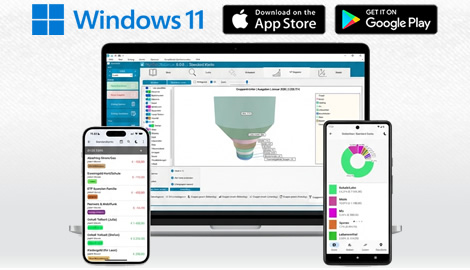
Download the Budget Tracker MyMicroBalance for Windows, Android or iOS