30. January 2026 | How-Tow

What Is the 50/30/20 Rule? Simple Explanation With Euro Examples for Your Budget

What Is the 50/30/20 Rule? Simple Explanation With Euro Examples for Your Budget

What Is the 50/30/20 Rule?

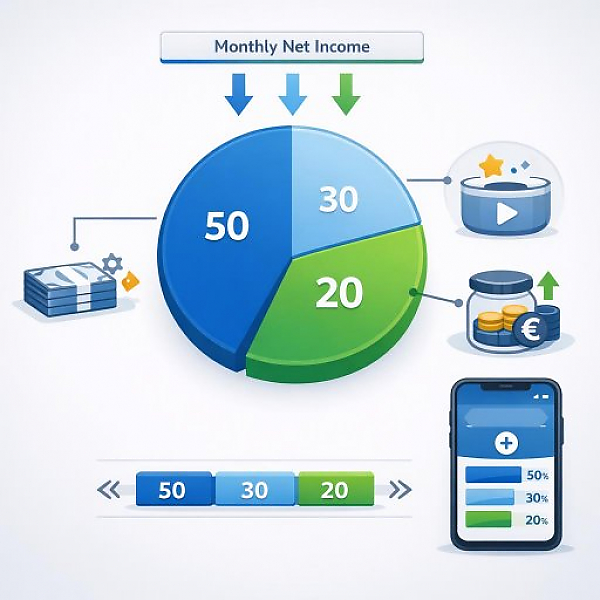
The 50/30/20 rule is a simple budgeting method. It splits your monthly net income (pay after taxes and deductions) into three parts: 50% for essential expenses, 30% for wants, and 20% for financial goals such as savings or debt payoff.

How the 50/30/20 Rule Works in Real Life

The rule helps you get a clear overview of your spending. You assign every expense to exactly one of the three main groups:

  • 50% – Essential expenses: Everything you truly need to keep daily life running. For example, rent, basic groceries, electricity, heating, public transportation, basic insurance.
  • 30% – Wants: Things that are nice to have but not necessary for survival. For example, dining out, streaming subscriptions, shopping, hobbies, leisure.
  • 20% – Financial goals: Money that improves your future. For example, an emergency fund, savings for repairs, larger purchases, or paying down debt.

Example Calculation: The 50/30/20 Rule With Different Net Incomes

The table below shows how three different net incomes could be split using the 50/30/20 rule. The amounts are rounded and are for illustration only.

Net income per month 50% – Essential expenses
(Amount & typical items)
30% – Wants
(Amount & typical items)
20% – Financial goals
(Amount & typical items)
€1,800 €900
e.g.: rent, utilities, electricity, basic groceries, monthly public transit pass
€540
e.g.: restaurants, streaming, clothing, small hobby budget
€360
e.g.: emergency savings, paying back small installment loans
€2,500 €1,250
e.g.: rent, heating, electricity, internet, cell phone, basic groceries, daycare fee
€750
e.g.: leisure, short trips, club memberships, gym, shopping
€500
e.g.: building an emergency fund, saving for a car or renovation
€3,200 €1,600
e.g.: rent or mortgage payment, insurance, transportation, groceries
€960
e.g.: vacation, restaurants, hobbies, electronics, events
€640
e.g.: growing your emergency reserve, larger planned purchases, debt payoff

When the 50/30/20 Rule Makes Sense — and When It Doesn’t

The 50/30/20 rule is especially helpful if you:

  • are tracking a budget for the first time,
  • want a simple guideline for your budget,
  • want to quickly see whether your fixed costs are too high.

It’s less suitable if your situation is very tight—for example, if you have high debt or very low income. In that case, 20% toward financial goals may be hard to reach. The rule isn’t a rigid requirement; it’s a guideline. You can adjust the percentages to fit your life situation.

Step by Step: Using the 50/30/20 Rule With a Budgeting App

With a budgeting app like MyMicroBalance, you can use the rule systematically. Proceed as follows:

Step 1: Calculate and record your monthly net income

  • Add up all regular net income per month—for example, salary, regular support payments, or pensions.
  • Use an average if your income fluctuates—for example, the mean of the last 3 to 6 months.
  • Enter this amount once in MyMicroBalance as a reference value for your monthly budget (e.g., as a note or budget goal).

Step 2: Create three main categories

Set up three clear main categories in your budgeting app:

  • Essential expenses (50%)
  • Wants (30%)
  • Financial goals (20%)

Under these main categories, you can create subcategories. For example:

  • Under “Essential expenses”: rent, groceries, electricity, public transportation.
  • Under “Wants”: restaurants, leisure, shopping, digital subscriptions.
  • Under “Financial goals”: emergency fund, savings for a car, paying back debt.

Step 3: Assign every expense to a category

  • Review your existing expenses from the past weeks or months.
  • Assign each item to exactly one of the three main categories.
  • Be consistent: an expense should always belong to only one category.
  • Going forward, enter new expenses directly when you pay in MyMicroBalance and select the appropriate category.

Step 4: Review at the end of the month and adjust

Use the analysis view in your budgeting app to check the split.

  • Compare: What percentage of your money went to “Essential expenses,” “Wants,” and “Financial goals”?
  • Check how close you are to the benchmarks of 50%, 30%, and 20%.
  • Ask yourself, for example:
    • Am I clearly above 50% for essential expenses? Then rent or ongoing contracts may be very high.
    • Is more than 30% going to wants? Then next month I can intentionally cut back on leisure or shopping.
    • Is the share for financial goals below 20%? Then I can try to increase my savings rate step by step.
  • Set specific, small adjustments for the next month—for example, cancel one subscription or set a fixed savings target.

Tips for Using the 50/30/20 Rule Long Term

  • Start with a 1–2 month baseline review before sticking strictly to percentages.
  • Adjust the percentages if your situation requires it—for example, 60/20/20 or 55/25/20.
  • Use reminders in MyMicroBalance to review your reports regularly.
  • Think of the rule as a compass. It shows the direction, but you decide how fast you move.

Conclusion: The 50/30/20 Rule as an Easy Entry Into Budgeting

The 50/30/20 rule gives you a clear framework for your monthly budget: 50% for essential expenses, 30% for wants, and 20% for financial goals. With a structured budgeting app like MyMicroBalance, you can bring this simple formula into your daily life and gradually gain more control over your money.

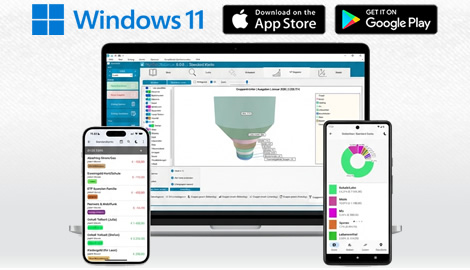
Download the Budget Tracker MyMicroBalance for Windows, Android or iOS