

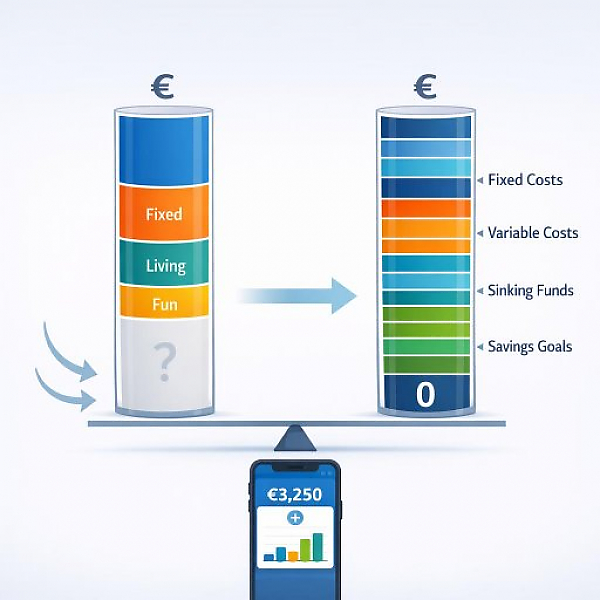
Zero-based budgeting means you allocate your entire monthly net income across different categories so that, at the end of planning, $0 is left over on paper—not because you don’t save, but because sinking funds and savings goals are treated like their own spending categories.
With traditional budgeting, many people set only rough limits. For example, they plan for rent, groceries, and entertainment. The rest remains as a “buffer” in the account. With zero-based budgeting, every dollar gets a specific job. You also set aside fixed amounts for irregular expenses, such as insurance or vacations.
| Method | Starting point | Category overview | Example allocation with €2,000 net | Typical advantages | Typical disadvantages |
|---|---|---|---|---|---|
| Traditional budgeting | Part of the income is planned (e.g., fixed costs and some entertainment). A remaining amount stays unassigned in the account. | Usually only broad areas: – Fixed costs (rent, electricity, internet) – Living expenses (food, transportation) – Entertainment / miscellaneous Sinking funds and savings goals are often not tracked separately. | Example with €2,000 net: – €800 rent and utilities – €300 groceries – €150 transportation (public transit, gas) – €150 entertainment / miscellaneous – €600 without a specific assignment (buffer, spontaneous spending) => Not all income is specifically planned. | – Easy to get started, low effort – Spontaneous spending is always possible – Feels flexible | – Unclear where the “rest” actually goes – Sinking funds for annual costs are easy to forget – Savings goals are often not reached consistently |
| Zero-based budgeting | The entire net income (100%) is allocated to categories before the month begins. Income minus the sum of all categories = €0 (on paper). | Detailed breakdown, for example: – Fixed costs (rent, electricity, internet) – Variable costs (food, transportation, entertainment) – Sinking funds (irregular expenses such as insurance, repairs, vacation) – Savings goals (e.g., emergency fund, larger purchases) | Example with €2,000 net: – €800 rent and utilities – €300 groceries – €150 transportation – €150 entertainment – €150 sinking fund for annual insurance premiums – €100 sinking fund for car/apartment repairs – €150 sinking fund for vacation – €200 savings goal: emergency fund – €100 savings goal: larger purchase Sum of all categories = €2,000 Income (€2,000) – plan (€2,000) = €0 (on paper). | – Full control over every dollar – Sinking funds are built into the plan – Savings goals are treated as a “must” in the budget – Better understanding of your own money habits | – Slightly more planning effort – Discipline is needed to stick to the limits – Unfamiliar at first because the “free leftover amount” disappears |
In zero-based budgeting, the 0 does not mean you have no money left. It only means: your entire income is allocated to meaningful purposes. Money for future expenses and wealth building also gets its own category. Your account balance can be positive, but your plan has already assigned every dollar a job.
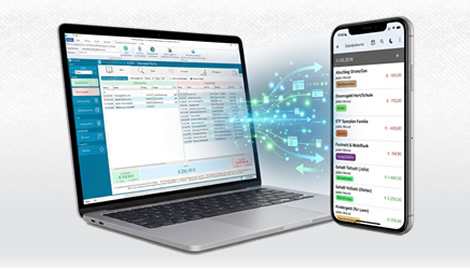
Zero-based budgeting is easy to implement with a digital budget tracker like MyMicroBalance. Keep the process as simple and repeatable as possible.
Now define all categories you want to allocate your income to.
In MyMicroBalance, you can set up these areas as categories or virtual pots. Virtual pots mean: the money stays in your bank account, but in your plan it’s mentally divided up.
Important: You’re allowed to change the amounts until they’re realistic for you. Zero-based budgeting isn’t a rigid system—it’s a plan you actively shape.
For zero-based budgeting to work, planning alone isn’t enough. You should also record your actual spending.
Zero-based budgeting is especially helpful if you:
Traditional budgeting is simple and fast. But it offers less control and often leaves questions unanswered—for example: Will my money cover annual costs and emergencies?
Zero-based budgeting is more precise. You can see where every dollar is supposed to go. That increases transparency, but also the planning effort. With a digital budget tracker like MyMicroBalance, that extra effort can be greatly reduced because many steps repeat and can be adjusted month by month.
You can also transition gradually: start with a few additional categories for sinking funds and savings goals, and then develop your system over time into a complete zero-based budget.

 1
1 2
2 3
3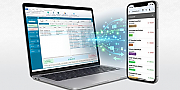 4
4

