

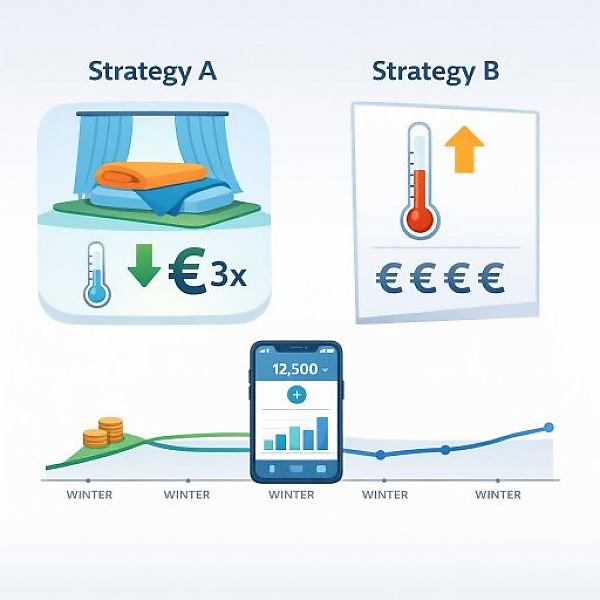
Binge-watching at night, working from home at the dining table, game nights on the couch: In winter, life often happens in the living room. That’s exactly where the heat then runs for many hours a day. The question is obvious: Is it cheaper to make the room cozier and feel warmer with rugs, curtains, and blankets—or just turn the thermostat up one or two notches?
The common thought: “Turning the heat up one setting has to be cheaper than buying rugs, curtains, and the like.” This article takes a closer look at a typical living room over a winter month and compares two approaches.
For this comparison, we’re only looking at the living room. The other rooms stay just as warm as before.
The sample calculations are fictional but realistic and are mainly meant to show you how to estimate the order of magnitude for your own household.
To make costs comparable, we need a few assumptions for a typical living room:
Important: The following numbers are for orientation and are intentionally rounded so they stay easy to follow.
Typical rule of thumb: Lowering room temperature by 1 degree saves about 6% heating energy. That applies to the whole home, but it’s a good directional guide.
Let’s assume your total heating bill for a winter month, with unchanged behavior, would be about €180. The living room accounts for about one third of that, or roughly €60 per month.
If 1 degree less saves about 6%, that means:
Turning the heat 2 degrees higher, on the other hand, makes the living room in our example about €7–€8 more per month. It doesn’t sound dramatic at first, but it adds up over the whole winter.
Let’s first look at the seemingly convenient solution: don’t rearrange anything, don’t buy anything new, just turn the thermostat up.
| Item | Monthly additional cost (fictional) |
|---|---|
| 2 degrees more in the living room | about €7.20 |
| Over 5 winter months | about €36 |
In cold winters or very drafty apartments, this number can be significantly higher; in well-insulated homes, it may be lower. One thing is clear: Every additional degree costs you money again every winter month.
Financial advantage of Strategy B: No one-time costs. Downside: The additional costs happen every year again. Also, at higher temperatures the air often feels drier and less comfortable—especially if the room is poorly insulated.
Now for the alternative: Set up the living room so it feels warm even at a slightly lower air temperature. The focus is on:
The goal: 1–2 degrees less heat with the same comfort level.
Let’s assume you intentionally make your living room feel “warmer” without blowing your budget. That could look like this:
One-time cost: €110.
With these measures, you manage to lower the living room temperature from 72°F (22°C) to 68°F (20°C) without feeling cold. The savings:
After about 3 heating seasons, the purchases in this example would have paid for themselves purely through the living room, on paper. If the rug and curtains stay in use longer, you keep benefiting from the savings in the winters that follow.
The myth is: “Before spending money on rugs and curtains, it’s better to turn up the heat—that’s cheaper.”
The sample calculation shows something else:
The key is looking beyond just one month. If you turn it up a few degrees winter after winter, you pay for it year after year—without any lasting value.
Many people know the feeling: The hallway is cool, and the living room feels almost tropical. Between the kitchen, bathroom, and living room there’s a small temperature shock that often tempts you to make the living room even warmer.
A better idea is to create targeted comfort zones in the living room:
These zones are used especially in the evenings—exactly when the heat runs the most. The better they stay “passively” warm, the easier it is to lower the thermostat temperature a bit.
Even on a tight budget, you can accomplish a lot in the living room. What matters isn’t whether everything is bought new, but how smartly you plan.
For households on a tight budget, it can help to deliberately mark purchases related to warmth in the household budget. That makes it visible that these expenses aren’t just “decor,” but can reduce heating costs over the long run.
One possible approach:
Especially with used rugs and curtains, you can achieve a lot with little money. These purchases aren’t “used up” after one season—they can stick with the household for multiple winters.
Not every measure fits every living situation. Still, there’s a clear direction for both.
| Aspect | Strategy A: Insulate cozily with furnishings | Strategy B: Turn up the heat |
|---|---|---|
| Upfront cost | One-time purchases (rug, curtains, blankets) | No extra cost at the start |
| Ongoing costs | Lower heating costs with 1–2 degrees less | Higher heating costs every month |
| Comfort | Warmer feet, less draft, cozier room | Fast warmth, but often drier air; cold floor remains |
| Flexibility | Furnishings can move with you; adaptable to new spaces | Tied to the current home |
| Financial impact | Pays off over multiple winters; saves long-term | Costs recur every year |
In the winter living room, what matters less is the number on the thermostat and more your personal sense of warmth. A room with a warm floor, closed curtains, and cozy blankets can feel more pleasant at 68°F (20°C) than a bare room at 72°F (22°C).
Simply turning up the heat is convenient in the short run, but it gets paid for—again and again—year after year. If you instead invest intentionally in rugs, curtains, and smart furniture placement, you can usually lower the living room temperature by 1–2 degrees without sacrificing comfort. These measures help make heating costs more manageable and keep winter evenings in the living room from becoming a cost trap.





 1
1 2
2 3
3 4
4

