

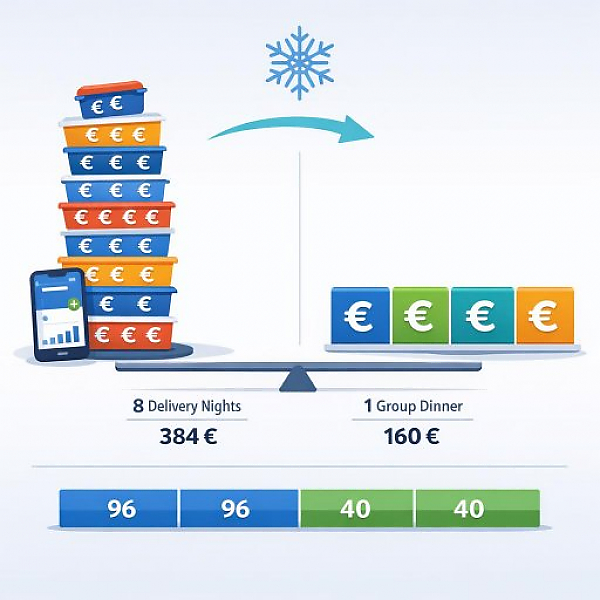
It’s dark, cold, and wet outside, and the first month after the holidays feels long—right when the temptation to order delivery regularly is at its biggest. One click, food arrives, everyone’s full. In your household budget, those nights show up later as harmless-looking individual charges, until you look at the end of the month and realize: It was a lot more than you planned.
Especially in January and February—when heating costs, insurance, and maybe leftover holiday spending are weighing on your account—it’s worth taking a closer look at food expenses. One way to get through this season with less stress: planned winter group meals instead of spontaneous delivery orders.
Imagine a four-person shared apartment in a mid-sized city: two students, one apprentice, and one recent graduate starting a first job. Everyone uses a digital household budget to keep an eye on rent, utilities, and groceries. December is stressful, January is cold—and the household decides: “Let’s treat ourselves more often and just order in.”
Here’s what a typical January without a plan looks like:
In the household budget, these expenses show up spread across all four people, for example:
It felt like “ordering a few times.” In reality, those nights cost nearly as much as half a weekly grocery run per person. Then the rest of the month, people cut back elsewhere—often without a plan and with a bad feeling.
In February, the household decides to do it differently. The goal: eat together without overloading the account. Instead of ordering first and checking the household budget afterward, they plan first and then cook.
The group sets three simple rules:
The household chooses 40 euros per week for two big shared meals. With four people, that’s 10 euros per person per week. In the household budget, they create a separate category for it, for example:
All purchases for these nights are consistently assigned to this category, separate from normal grocery shopping. This way, at month’s end, everyone can see:
For the two shared dinners per week, the household picks dishes that work well in large batches and use seasonal ingredients. For example:
Two example dishes with concrete numbers show how costs change compared with delivery.
For four people—once as a hot dinner and once reheated:
Total cost: 8.80 euros for about 8 servings (four large and four smaller).
Cost per serving: 8.80 euros / 8 servings = 1.10 euros.
Compared to delivery pizza for 12 euros per person, it looks like this:
| Option | Total cost | Servings | Cost per person/serving |
|---|---|---|---|
| Delivery pizza | 48 euros (4 × 12 euros) | 4 | 12.00 euros |
| Roasted veggies | 8.80 euros | 8 | 1.10 euros |
So on a single night, the household saves about 39 euros compared with ordering—and even has leftovers for the next day.
For eight hearty servings:
Total cost: 9.10 euros for 8 servings.
Cost per serving: 9.10 euros / 8 servings ≈ 1.14 euros.
Here too, there’s clear savings compared with a hot convenience meal or a daily delivery deal. In the household budget, this night appears as a shared expense of 9.10 euros in the “Group meals” category, split across four people: about 2.28 euros per person.
For many people, cutting out delivery entirely is unrealistic. That’s why the household sets a clear, honest compromise rule:
The effect: delivery stays something special, doesn’t become a habit-click, and stands out clearly in the month-end review. Instead of eight spontaneous delivery nights like in January, there’s now one planned “luxury night” and several low-cost cooking rounds.
So no one feels like they’re always taking care of everyone, the household sets a rotating plan. It can look like this:
Possible models to keep effort and spending fair:
What matters is a clear agreement: Which meals count as group meals? Who’s up when? And how are amounts split within the household? The clearer the rules, the more relaxed the evenings.
To keep the new habits from disappearing again after two weeks, simple routines with a digital household budget help:
After two months, the household takes stock and compares the January delivery marathon with February’s group meals.
| January (no plan) | February (with plan) | |
|---|---|---|
| Number of delivery nights | 8 | 1 |
| Total delivery cost | 384 euros | 48 euros |
| Group-meal budget per week | not available | 40 euros |
| Actual spending on group meals | 384 euros (delivery only) | about 160 euros (4 weeks × 40 euros) |
| Per-person spending for these nights | 96 euros | about 40 euros |
Result: about 56 euros more stays in each person’s wallet—and that in just one winter month. In a four-person household, that’s about 224 euros total difference between “We just order when we’re hungry” and “We plan two group meals per week.”
The principle doesn’t only work in shared apartments. Young families, single parents with friends who are also parents, or student friend groups can build similar routines:
What matters most isn’t the perfect recipe, but the combination of planning, a fixed spending limit, and transparent tracking in the household budget.
Especially in winter, food is about more than getting full—it brings warmth, togetherness, and small bright moments in gray everyday life. When delivery becomes a habit, what’s left at the end of the month is mostly a noticeable hole in the budget. With a fixed group-meal budget, simple winter recipes, a rotating cooking plan, and a clear compromise rule for delivery, the cold months can feel a lot more manageable.
If you track your delivery spending and group-meal spending separately in your household budget, you’ll quickly notice: a planned pot of stew or a sheet pan of roasted vegetables doesn’t just ease your bank account—it regularly gets people around a table, and that’s exactly what makes long winter evenings much easier.


 1
1 2
2 3
3 4
4

