14. December 2025 | How-Tow

Winter Travel Cost Check: Leave the Car Parked or Get a Public Transit Pass—What Really Eases Your Budget

Winter Travel Cost Check: Leave the Car Parked or Get a Public Transit Pass—What Really Eases Your Budget

Two winter habits compared

Winter makes it especially clear how expensive mobility really is. Morning cold, traffic jams in the snow, pricey parking downtown or at the train station—at the same time, monthly and season passes in local public transit offer fixed, predictable costs.

In everyday life, many decisions happen on autopilot: grab the keys, drive off. But especially for budget-conscious families, single parents, students, and commuters, it’s worth taking a closer look: Is the car really cheaper in winter—or does a public transit pass ease the budget more?

This article compares two clear behaviors:

  • Habit A: Keep using your own car as usual, even in winter
  • Habit B: Consciously switch to a public transit pass or monthly ticket in winter

With simple sample numbers, calculation steps, and a small 4-week exercise, you can realistically assess your own situation.

Habit A: Keep using the car as usual—what winter adds

Most car costs arise regardless of the season: insurance, vehicle tax, depreciation, maintenance. In winter, however, there are a few factors that make driving more expensive—often without you noticing.

Typical winter trips

  • Daily commute to work or university
  • Extra trips in the dark (kids’ activities, errands, doctor’s appointments)
  • Visits to family and friends during the holidays
  • Winter outings (sledding, thermal spa, short trips)

All of that adds up to many miles in just three to four winter months. The more short trips and stop-and-go traffic, the more costs rise.

Hidden winter costs of driving

For a realistic comparison, it’s not enough to look only at fuel. These costs are especially relevant in winter:

  • Higher fuel use due to cold and cold starts: The engine, oil, and tires are cold; the heater and lights run more. Short trips push consumption up.
  • Winter tires and their wear: Even if you buy them in fall, over the years the tires are “used up” specifically in winter.
  • Antifreeze, windshield washer fluid, ice scraper, lock de-icer: Small amounts, but recurring every year.
  • Parking fees: If you don’t want to walk far because of snow, you’ll more often pay for closer spots or garages.
  • Traffic and weather costs: More time in traffic means more fuel and wear—even if it’s not a direct line item in an app.

Concrete example: A family car in winter

Example: A family of four in a mid-sized city with a subcompact car (gasoline).

  • Commute: 15 km one way, 5 days per week
  • Extra trips (shopping, kids, leisure): on average 50 km per week
  • Winter period: 3 months (about 13 weeks)

1. Calculate winter kilometers

  • Commute per week: 5 days x 30 km (round trip) = 150 km
  • Extra trips: 50 km
  • Total per week: 200 km
  • In 13 weeks: 13 x 200 km = 2600 km in winter

2. Fuel costs in winter

Assumed summer consumption: 6.0 l/100 km. In winter it rises due to cold starts and short trips to 6.8 l/100 km (+ ~13%). Assumed fuel price: 1.90 euros per liter.

  • Fuel used over 2600 km: 2600 x 6.8 / 100 = 176.8 liters
  • Rounded: 177 liters
  • Fuel cost: 177 x 1.90 euros 8 336 euros

At summer consumption (6.0 l/100 km) it would be about 296 euros. The winter increase in consumption is therefore around 40 euros for 3 months.

3. Other typical winter costs (plausible average values for 3 months):

  • Winter tire wear (share per winter, depreciated over several years): about 40 euros
  • Windshield antifreeze, winter washer fluid, replacement ice scraper, etc.: about 20 euros
  • Additional parking fees (downtown, holiday season, events): about 5 euros per week x 13 weeks 8 65 euros
  • Other wear from more frequent short trips (brakes, battery, exhaust—lump sum): about 30 euros

4. Total winter car costs (in addition to fixed costs like taxes/insurance):

Cost type3 months
Fuel336 euros
Winter tire share40 euros
Antifreeze & small items20 euros
Parking fees65 euros
Wear-and-tear buffer30 euros
Total491 euros

The car’s fixed costs (insurance, vehicle tax, depreciation) continue anyway, of course. They are intentionally not included here because they’re independent of whether the car is used a lot or a little during these 3 months.

Habit B: Switch to a public transit pass in winter

The alternative: The car sits more often in winter—or even completely. Instead, you use a monthly ticket, a season pass, or a semester pass.

What does a public transit pass realistically cost?

Actual prices vary by city and region. For orientation, here’s a plausible example for a transit authority in Germany, Austria, or Switzerland:

  • Monthly pass for a city + adjacent zone: 70 to 110 euros per month
  • Weekly passes for occasional use: 25 to 40 euros per week
  • Discounts for apprentices, students, seniors, or family discounts

For the comparison, we assume: One person uses a monthly pass for 90 euros in winter.

Example calculation: Commuting with a pass

The same commute as above: 5 days per week to work, plus occasional trips for shopping and leisure.

Assumed model:

  • Pass (3 months): 3 x 90 euros = 270 euros
  • Occasional extra trips outside the zones or with other modes (e.g., regional trains on holidays): 30 euros per month
  • Extra tickets for family (bringing someone along on weekends/evenings—often free depending on the fare, so only a small amount here): 10 euros per month

Total:

Cost type3 months
Pass270 euros
Extra trips90 euros
Family add-on tickets30 euros
Total390 euros

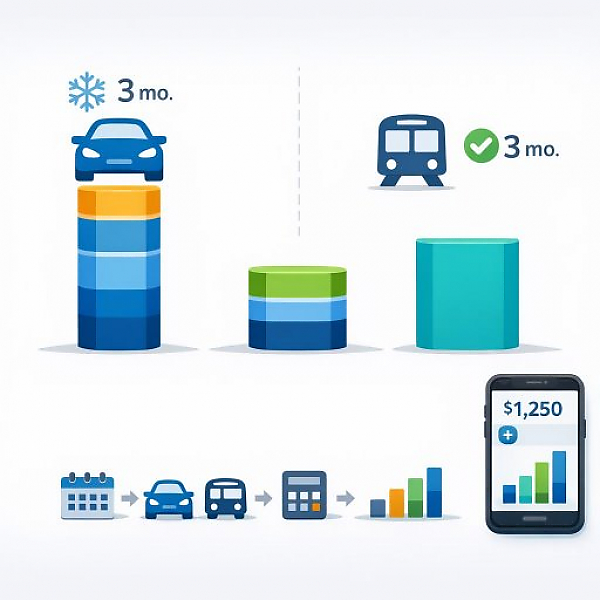
In the example, pure public transit costs are about 100 euros lower than the variable winter car costs (491 euros). The car still incurs fixed costs during this period, but every mile not driven saves fuel, parking fees, and wear.

Car vs. public transit in winter: When does which option pay off?

Whether the car or the pass is cheaper depends heavily on distance, life situation, and where you live. Some common patterns help with the assessment.

When the car often remains cheaper despite winter

  • Very rural regions with little or no public transit service
  • Several people ride together daily (carpooling in one car)
  • A very long commute but relatively little city traffic and free parking
  • Jobs with irregular, very early, or very late hours when buses or trains barely run

When public transit usually has the edge in winter

  • City or suburbs with good frequency and short walks to the stop
  • Expensive parking at work, college, or downtown
  • Many short trips and stop-and-go driving where consumption rises the most
  • Students and apprentices with inexpensive passes or semester tickets
  • Families with children who can cover school routes by public transit or on foot/by bike

Financially, a hybrid approach is often especially attractive: In winter, deliberately drive much less, shift core trips to public transit, and use the car only for specific routes (rural, outings, bulk shopping).

Saving tips for households and families in winter

With a few habit changes, winter trips can be bundled better and costs reduced—regardless of whether you keep the car or add a pass.

1. Organize carpools

  • Ask coworkers, neighbors, or other parents whether trips to work, school, or daycare can be shared.
  • Even a shared commute halves fuel costs for that route and reduces time spent hunting for parking.
  • For kids: Align activity schedules and set up fixed driving duties (Monday Family A, Wednesday Family B, etc.).

2. Plan school routes

  • Check whether kids can take the bus/train or walk instead of being driven daily.
  • If a car is necessary: Bring several neighborhood kids together instead of each family going separately.
  • Keep an eye on schedules and weather so you can leave early in icy conditions and avoid stress.

3. Bundle weekly grocery runs

  • Instead of “just quickly grabbing something” several times a week: plan one larger weekly shop.
  • Combine the grocery run with a trip you’re already making (e.g., on the way home from work or a child’s activity).
  • This eliminates many short trips that are especially expensive by car (cold start, parking).

4. Use cheaper time windows in public transit

  • Many transit authorities offer discounts for off-peak times or inexpensive day passes on weekends.
  • Schedule errands or leisure trips in those time windows if possible.
  • Look closely at family fares and rules for bringing others along: Often kids ride free all day or in the evening.

Saving tips for students in winter

Students often have special ways to keep mobility affordable—especially if they already have a semester ticket.

1. Use your semester ticket consistently

  • Check which zones and modes are covered (city transit, regional trains, evening rules).
  • Keep university, side job, shopping, and leisure trips as much as possible within the ticket area.
  • Make trips not covered intentionally less frequent or organize carpools.

2. Bundle trips to side jobs

  • If multiple shifts are flexible, plan as few commutes per week as possible.
  • Run errands or handle personal to-dos on workdays.
  • Carpool with coworkers if the workplace is outside the public transit area.

3. Weigh discount rail cards against winter car costs

If you commute between your university city and your hometown, you often face a choice: drive the longer route by car more often or use discounted rail options. A comparison is worth it:

  • Estimated car costs per trip (fuel, wear, parking) vs. ticket price with a discount card
  • Time savings: study or relax on the train instead of driving tensely in snowfall
  • Plan overnight stays on site so you don’t travel back and forth too often

Practical mini exercise: Your 4-week winter trip log

To decide whether the car or a public transit pass really makes winter cheaper, your own numbers help more than any sample calculation. A simple log over 4 weeks is often enough.

Step 1: Write everything down for 4 weeks

For each trip:

  • Date
  • Purpose (e.g., work, shopping, kids, leisure)
  • Kilometers (car) or ticket price (public transit)
  • Parking fees (if car)
  • Passengers (for later cost splitting in carpools)

You can do this the old-fashioned way in a notebook or directly in a digital household budget as its own category called “Winter trips.”

Step 2: Add up the totals after 4 weeks

Now evaluate the data. Helpful questions:

  • How many car kilometers did you log in total?
  • How much fuel did you buy (liters and euros)?
  • How high were total parking fees?
  • How much did you spend on single tickets or short trips in public transit?

Then draw a realistic comparison: How expensive would it have been if, instead of single tickets, you had used a table with monthly pass costs—and conversely, if instead of the car you had used a public transit subscription?

Step 3: Simple analysis for your personal winter mobility budget

Based on the 4-week values, you can roughly extrapolate to 3 winter months:

  1. Total variable car costs (fuel + parking + any small items) x 3
  2. Total public transit costs (tickets, day passes) x 3
  3. Compare with the fares in your own city/region to see what a pass would cost over 3 months

This creates a simple table:

OptionTotal cost 3 months (estimate)
Use the car intensively...
Hybrid (reduced car use + more public transit)...
Mainly public transit with a pass...

The cheapest option doesn’t automatically have to be the most convenient. But often you’ll see that even small changes—like one additional public-transit day per week or consistently bundling trips—can lead to meaningful savings.

Conclusion: Winter is the best time to review mobility habits

Winter months are more expensive than many people realize—especially by car. Higher consumption due to cold, winter tires, parking fees in crowded downtown areas, and heavier traffic during short days drive spending up. A consciously used public transit pass, carpools, and bundled errands can noticeably ease a household budget.

If you take a close look for 4 weeks at which trips cost what, you create a solid basis for decision-making: keep using the car as before, switch more heavily to buses and trains, or choose a hybrid solution. That turns the often expensive winter season into a phase when mobility is planned better, costs become more transparent, and your budget can finally breathe a little.

Download the Budget Tracker MyMicroBalance for Windows, Android or iOS