

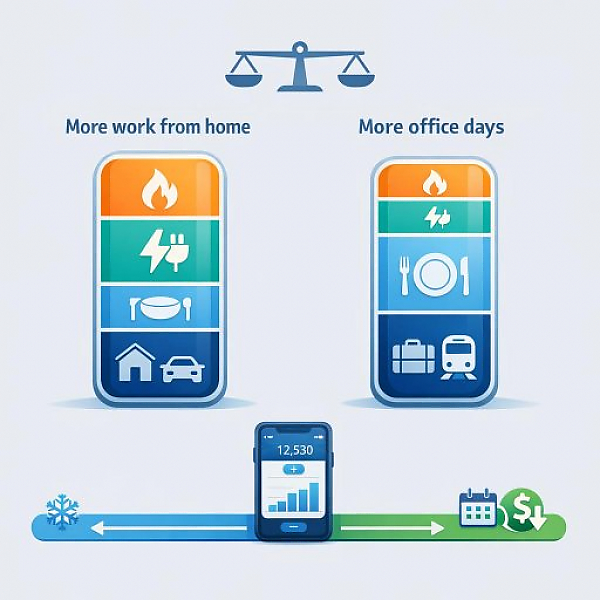
In summer, working from home often feels like a savings plan: fewer trips, fewer expenses while you’re out. In winter, the math changes. Your place has to be heated longer and more intensely, lights and tech run for more hours, and at the same time commuting conditions and eating habits shift.
This comparison shows how two behaviors affect your winter budget:
All figures are fictional but realistic averages for Germany, Austria, and Switzerland. They help you transfer the principle to your own budget.
In winter, four major cost blocks shift depending on whether you work at home or in the office:
The key is to look at these blocks not in isolation, but in context.
The following examples assume a 5-day workweek in winter and compare:
The amounts are monthly figures.
Assumption: 30 m² apartment, gas heating, good access with a semester transit pass.
| Cost type | Model 1 3 days work from home | Model 2 1 day work from home |
|---|---|---|
| Heating (additional winter usage due to work from home) | approx. €20 | approx. €10 |
| Electricity (PC, light, hot water) | approx. €10 | approx. €5 |
| Commuting costs (prorated semester pass) | approx. €15 | approx. €20 |
| Food on the go (coffee, snacks, cafeteria) | approx. €35 | approx. €55 |
| Total costs | approx. €80 | approx. €90 |
Bottom line for students: More work from home can be cheaper in winter despite slightly higher heating and electricity costs — especially if the pass is inexpensive or necessary anyway and food on the go is noticeably more expensive.
Assumption: 60 m², central heating, commuting by public transit without an employer transit pass.
| Cost type | Model 1 3 days work from home | Model 2 1 day work from home |
|---|---|---|
| Heating (additional winter usage due to work from home) | approx. €45 | approx. €25 |
| Electricity (laptop/PC, light, possibly an electric kettle) | approx. €15 | approx. €8 |
| Commuting costs (monthly pass or single rides) | approx. €60 | approx. €90 |
| Food on the go | approx. €40 | approx. €70 |
| Total costs | approx. €160 | approx. €193 |
Bottom line for singles: As soon as commuting costs start to matter, a well-organized winter work-from-home setup often pays off financially — as long as you don’t heat the entire place nonstop, but instead heat strategically based on need.
Assumption: 110 m², two adults (one working from home, one mostly in the office), one school-age child. Commuting by car.
| Cost type | Model 1 3 days work from home | Model 2 1 day work from home |
|---|---|---|
| Heating (additional usage because it’s kept warm during the day) | approx. €60 | approx. €35 |
| Electricity (home office, lighting, equipment) | approx. €20 | approx. €10 |
| Car costs (gas, wear and tear) | approx. €90 | approx. €140 |
| Food on the go (cafeteria, bakery) | approx. €60 | approx. €90 |
| Total costs | approx. €230 | approx. €275 |
Bottom line for families: Here, the car usually eats up the biggest share of the budget. More days in the office rarely makes financial sense if the commute is long and the cafeteria is expensive. On the other hand, work-from-home increases heating needs — especially if multiple rooms are kept warm at the same time.
Heating is the decisive cost block for winter work from home. With a few adjustments, you can limit the extra usage surprisingly well.
What matters is that your heating strategy aligns with your work-from-home days. A typical approach that makes sense:
In many households, the heat runs “all the time” in winter. More economical is:
Often it’s enough to keep the workspace moderately warm during the day and only bump up living areas a bit after work.
Instead of bringing your entire place up to office temperature, it’s worth creating a spot-heated workspace. That means: warm yourself and your immediate surroundings rather than every room.
Electric space heaters can seem practical, but they’re often expensive to run. They make sense mainly when:
If the overall room temperature rises significantly, electricity costs can quickly eat up the benefit. It helps to create a separate winter electricity line item in your budget and check the difference after a few weeks.
Whether winter work from home is actually cheaper depends heavily on your commute and your eating habits.
Include not only the ticket or gas, but also:
An example: 20 km (12 miles) one-way commute by car, 4 office days per week, 16 round trips per month. At €0.25 per kilometer, monthly costs are already:
20 km x 2 x 16 trips x €0.25 = €160
If you reduce to 2 office days (8 trips), these costs almost halve.
In everyday office life, a pattern can sneak in quickly:
Even at moderate prices, it’s easy to spend €6–€10 per day. At home, coffee and food from your own pantry often cost only a fraction.
The following table shows typical differences per additional office day in winter:
| Type | Additional cost per extra office day | Savings at home |
|---|---|---|
| Students with a semester transit pass | approx. €4–€6 (mainly snacks, cafeteria) | approx. €1–€2 heating and electricity savings |
| Single person with a public transit pass | approx. €8–€12 (ticket share, food) | approx. €2–€3 heating and electricity savings |
| Family with a car | approx. €12–€20 (gas, wear and tear, food) | approx. €3–€4 heating and electricity savings |
For many households, the rule is: An extra day at the office may save a bit of heating energy, but it quickly causes a multiple of that in commuting and food costs.
To find out which work model actually reduces your costs, a small “winter test” over 4–6 weeks is worth it.
In your digital budget tracker, you can create categories specifically for the winter months, for example:
What matters is entering these items consistently and as close to real time as possible.
Split a winter month (or better: six weeks) into two phases:
Enter all relevant expenses and make a brief note of how many work-from-home and office days you actually had in each phase.
At the end, compare the totals for the two phases:
Then divide the total cost of each phase by the number of workdays. That gives you an average cost per workday for both models, so you can clearly see which behavior is cheaper for your household.
There’s no one-size-fits-all answer, but there are a few typical patterns:
In winter, what determines whether working from home or going to the office is cheaper isn’t just the temperature outside, but above all your own behavior: How consistently do you set up heating zones, how often do you drive the car, how much money slips away each day via coffee at the station and a spontaneous cafeteria lunch?
If you align heating times specifically with work-from-home days, warm your workspace selectively, and keep an eye on commuting and food costs, you can save noticeably even in the cold season. A dedicated “winter work-from-home” line item in your budget will show within a few weeks which work model actually pays off.




 1
1 2
2 3
3 4
4

