

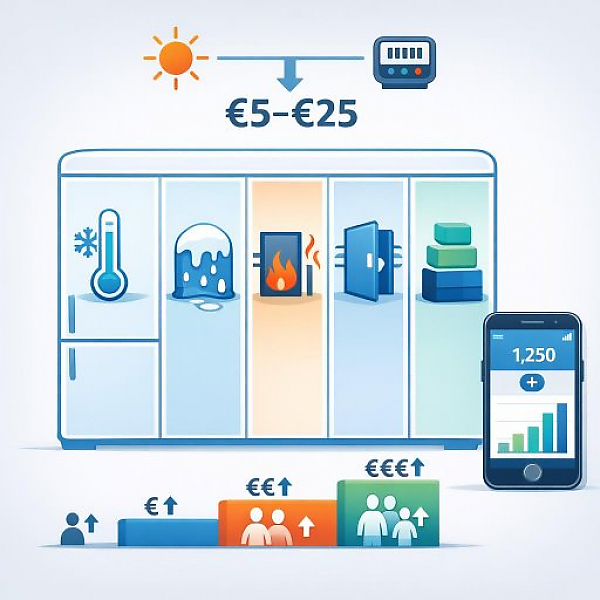
If you set your refrigerator and freezer correctly, defrost regularly, and place them well, you’ll typically save €5–€25 per month in summer. Over a year, that’s often €60–€300—without buying a new appliance.
Many appliances run too cold in summer. Or they’re heavily iced over. Or they sit right next to the stove or in the sun. That wastes electricity. With a few simple changes, you can get those costs back.
Key assumptions for the calculation:
The table shows typical examples for a single person, a couple, and a family. Your exact values may vary. But you can clearly see: even simple steps save noticeable money.
| Household type | Appliance setup | Annual usage before (kWh) | Annual usage optimized (kWh) | Electricity price (€ / kWh) | Savings per year (€) | Savings per month (€) |
|---|---|---|---|---|---|---|
| Single | 1 small refrigerator with freezer compartment | 260 | 200 | 0,30 | €18 | €1.50 |
| Single (with an extra chest freezer) | 1 refrigerator with freezer compartment + 1 small chest freezer | 420 | 310 | 0,30 | €33 | €2.75 |
| Couple | 1 medium refrigerator + freezer compartment | 340 | 250 | 0,30 | €27 | €2.25 |
| Couple (with an extra upright freezer) | 1 refrigerator + 1 upright freezer | 520 | 380 | 0,30 | €42 | €3.50 |
| Family (3–4 people) | 1 large fridge-freezer combo | 450 | 320 | 0,30 | €39 | €3.25 |
| Family (with an additional chest freezer) | 1 large fridge-freezer combo + 1 chest freezer | 700 | 500 | 0,30 | €60 | €5.00 |
In summer, cooling appliances often run longer and use more electricity. If you use all five steps in this guide (temperature, defrosting, placement, door discipline, fill level), €5–€25 per month is realistic. Households with many or older appliances are often at the high end.
Too cold is expensive. Many people unknowingly set the refrigerator to 3–4 °C. That costs extra electricity with no real benefit.
How to set it optimally:
Your benefit: you save electricity immediately, but your food still stays safely fresh.
Store easily perishable items (e.g., ground beef) in the colder area. That keeps them safe even if you set the overall temperature to 7 °C.
Ice on the walls may look harmless at first. But every layer of ice acts like a blanket. The appliance has to work harder. That costs electricity.
Rule of thumb:
Your benefit: a defrosted appliance often uses 10–20% less electricity. With multiple appliances, that saves noticeable money.
In summer, the kitchen heats up quickly. If your refrigerator is right next to the stove or in the sun, it gets extra heat. Then the compressor runs more often.
Even small changes help. Sometimes it’s enough to rotate the appliance a bit or move it 30–50 cm.
Your benefit: the appliances run less. You save electricity, and the appliance lifespan often increases too.
If you leave the door open for a long time in summer, warm air flows in. The appliance then has to cool aggressively to get back to the target temperature.
Your benefit: you avoid unnecessary power spikes and reduce wear on the appliance. This has a strong effect especially with kids in the household.
A good fill level helps keep the temperature stable. That saves energy.
Your benefit: temperature fluctuates less. The appliance works more steadily and uses less electricity.
Your exact savings depend on many factors: age and efficiency class of the appliances, room temperature, usage habits, number of people. The examples in the table help you estimate the range.
You don’t have to do everything at once. Start today with one step:
This spreads out the effort. But the impact on your electricity bill lasts throughout the year.
With simple temperature fine-tuning, a consistent defrosting routine, a bit of space from the wall, and smarter use of doors and storage space, you can significantly reduce your summer electricity costs for cooling appliances. You don’t need new appliances or expensive add-ons. Just start today and keep the savings month after month.





 1
1 2
2 3
3 4
4

