12. November 2025 | How-Tow

Fall Tire Change: Buy Early or Last Minute—Which Budget Strategy Actually Saves Money?

Fall Tire Change: Buy Early or Last Minute—Which Budget Strategy Actually Saves Money?

Why the decision matters

A fall tire change is a fixed expense for many households: new winter tires, installation, balancing, and often storage for the summer tires. Depending on your strategy, the same services can cost noticeably different amounts—or create the risk of extra costs. In the comparison below, we look at two typical approaches: buying early with staggered payments versus last-minute with a one-time payment and a bundled service package.

Quick comparison by the numbers (sample scenarios)

The examples are realistically calculated for a midsize vehicle (4 tires). Prices may vary by region.

 Buy early / staggered savingLast minute / one-time payment with service bundle
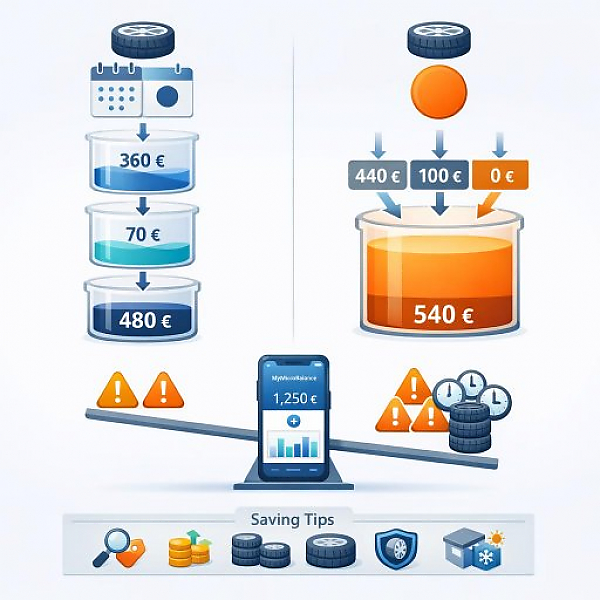
Tire price 4 tires at promotional price: 4 x 90 = 360 euros 4 tires at full price: 4 x 110 = 440 euros
Installation & balancing Basic shop appointment: 1 x 70 = 70 euros Service package (installation + balancing + quick check): 1 x 100 = 100 euros
Storage Separate storage: 1 x 50 = 50 euros Included in the package: 0 euros
Total 480 euros 540 euros
Payment method Can be staggered: e.g., 300 euros at purchase, 180 euros at installation/storage One-time payment when booking the appointment
Risk Low risk of selling out, but appointment backlogs are possible Higher costs, possible delays due to limited appointment availability

Pros and cons at a glance

  • Buy early / staggered saving
    • Pros: Lower promotional prices, spread payments across multiple months, less stress when the switching season starts.
    • Cons: You may need to store tires longer until the swap, need storage space at home, and if you shop carelessly you might order the wrong size.
  • Last minute / one-time payment with service bundle
    • Pros: Everything handled in one appointment, storage is often included, no need to set money aside for months.
    • Cons: Prices are usually higher, shops are busy and sometimes more expensive, and there’s a risk your preferred models sell out.

Five seasonal saving tips that help with both strategies

  • Early price monitoring & timing: Track prices over weeks, use price alerts, and buy during early deals (late summer/early fall). A small discount per tire adds up quickly.
  • Stagger costs: Instead of paying the full bill at once, buy the tires during a sale and pay for installation/storage later. Alternatively, save a small monthly buffer (e.g., 50 euros over 4 months = a 200-euro cushion).
  • Negotiate a bundle: Ask for a package price for installation, balancing, and storage. Group appointments with neighbors or family reduce trips and can lead to discounts with some providers.
  • Used & inspected: Well-preserved, certified tires with sufficient tread depth (at least 4 mm for longer lifespan) and a TÜV inspection can be significantly cheaper. Before buying, check tire age (year of manufacture) and look for damage.
  • Extend service life: Store correctly (cool, dark, upright or hung), check tire pressure regularly, and do a quick cleaning and visual inspection yourself before the season starts. Small maintenance reduces how often you have to buy new tires.

Practical implementation: How to proceed

  • Compare prices starting in July/August and set a price alert or note offers weekly.
  • Create a small seasonal account: deposits of 30–60 euros per month are often enough to cover the remaining costs.
  • Contact multiple shops and ask for package pricing; mention specific dates to check availability.
  • If space is tight, clarify storage options early; this avoids expensive last-minute solutions.
  • For inspected used tires: measure tread depth, check age (DOT number), and if needed get a second opinion at a shop.

Conclusion

Buying early with staggered saving saves money in most cases and reduces stress, because you can benefit from promotional prices and spread the costs more effectively. Last-minute with a service bundle can be worth it if a shop truly offers an inexpensive all-in package or if storage would be a short-notice problem. Overall, the cheapest strategy is the one that combines price tracking, early planning, and simple negotiation tactics. If you also focus on inspected used tires and proper storage, you can noticeably reduce costs over several years.

Download the Budget Tracker MyMicroBalance for Windows, Android or iOS